

Best Travel Games for Toddlers 2026: Screen-Free Picks
Table of Contents
- What Makes a Travel Game Work for Toddlers in 2026
- Road Trip Games for Toddlers: Car and Train Activities That Actually Work
- Airplane Activities for Toddlers: Compact, Quiet, and Tray-Table Ready
- Screen-Free Travel Games for Kids: Why They Beat Tablets on Long Journeys
- Toddler Travel Activities by Age: What a 2, 3, and 4-Year-Old Can Actually Play
- Common Mistakes Parents Make When Packing Travel Games
- How to Pack and Organize Travel Games So Nothing Gets Lost
- Conclusion: Choosing the Best Travel Games for Your Toddler in 2026
- Frequently Asked Questions
Last Updated: October 12, 2026
What Makes a Travel Game Work for Toddlers in 2026
The best travel games for toddlers in 2026 share four traits: they fit in a diaper bag, need no adult setup, survive being dropped, and hold attention for at least fifteen minutes.
At Are We There Yet, we've watched families wrestle with this on planes, trains, and gridlocked highways.
Below: what to buy, what to skip, and how to pack it so nothing gets lost.
Selection Criteria: Size, Rules, Safety, and Mess
Four filters separate a game that works on a long journey from one that ends in tears.
- Size: Must fit in a quart-sized bag or a seat-back pocket. If it needs its own tote, it stays home.
- Rules: A toddler should grasp the goal within one minute. Simple matching beats complex scoring.
- Safety: No pieces small enough to be a choking hazard for children under three. Check the manufacturer's age rating and supervise younger siblings.
Road Trip Games for Toddlers: Car and Train Activities That Actually Work
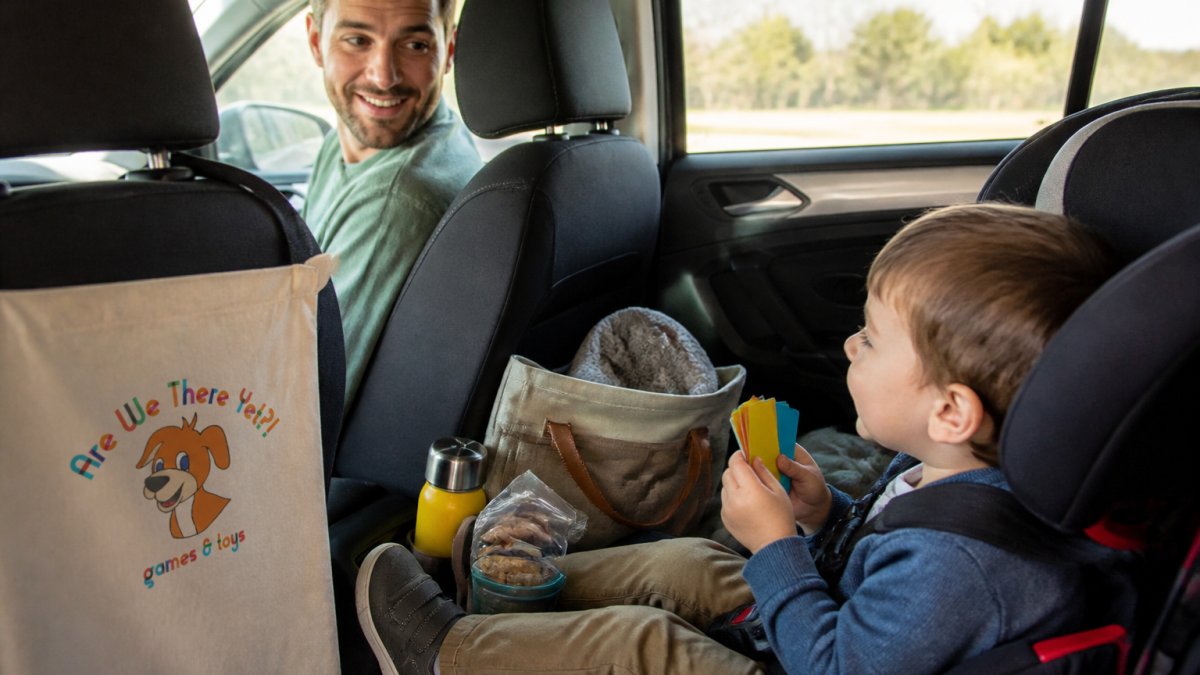
The best road trip games for toddlers are ones a child can play alone in a car seat: magnetic puzzles, reusable sticker books, and simple card games with big, colorful pictures.
Airplane Activities for Toddlers: Compact, Quiet, and Tray-Table Ready
Airplane activities for toddlers must clear three bars: quiet, small, and tray-table friendly. A deck of cards and a reusable sticker book beat almost anything with moving parts.
Space is the real constraint: a game that sprawls across two seats annoys your neighbor and frustrates your child. Felt activity books, magnetic tiles, and card games all fold to pocket size.
Noise matters too. Skip rattles, bells, and electronic sounds; aim for quiet play that won't draw stares on a red-eye.
Screen-Free Travel Games for Kids: Why They Beat Tablets on Long Journeys
Screen-free travel games for kids win on long journeys because they build real interaction instead of passive consumption.
That's practical, not moral.
The trade-off is honest: screen-free games ask more of you in the first ten minutes while you teach the rules once.
For families cutting device time, the best approach is a hybrid: screens as backup, games as default.
Toddler Travel Activities by Age: What a 2, 3, and 4-Year-Old Can Actually Play
Toddler travel activities should match what a child can physically and mentally do, not their birthday. The breakdown below uses developmental milestones rather than marketing age labels, because a game box that says "3+" often assumes skills a young three-year-old hasn't built yet.
Age 1 (12-23 months): Cause, Effect, and Mouthing
At this stage, play is sensory and exploratory. A one-year-old isn't playing a game with rules, they're discovering what happens when they push, pull, drop, or chew something. Attention span on a novel object runs roughly 1-3 minutes, and everything goes in the mouth.
- What works: Cloth books with crinkle pages, silicone teethers on a strap, large knob puzzles with chunky handles, stacking cups that nest, and busy boards with felt flaps.
- What to skip: Anything with pieces smaller than a toilet-paper tube (the standard choking-hazard test used by the U.S. Consumer Product Safety Commission), magnets that can detach, button batteries, and anything with strings longer than 7 inches.
- Supervision: Constant. A one-year-old should never be left alone with a travel activity, even for a minute in a car seat.
Age 2: Sorting, Stacking, and Matching
Two-year-olds can follow a single-step direction and notice categories, color, shape, size, but can't take turns reliably or handle losing, so competitive games are a non-starter. Realistic attention span is 5-10 minutes per activity, often less on a moving vehicle.
- What works: Color-matching cards, shape sorters, reusable sticker books, felt boards, magnetic fishing sets, and simple "find the matching pair" games with only 4-6 pairs.
- What to skip: Turn-taking games, scoring, timers, and anything with more than about 10 loose pieces.
- Supervision: Close by. Two-year-olds still mouth small items, so check every piece against the tube test before the trip.
Age 3: Memory, Picture Bingo, and One-Step Rules
Three-year-olds can hold a rule in mind for a short game, recognize familiar images quickly, and enjoy the social side of play. Attention span stretches to 10-15 minutes with a favorite activity, and they can handle a simple "your turn, my turn" rhythm, though they may still melt down when they lose.
- What works: Memory matching games with 8-12 pairs, picture bingo, I-spy cards, magnetic dress-up sets, and simple card games where the goal is matching rather than winning.
- What to skip: Complex scoring, multi-step rules, and games that require reading.
- Supervision: Nearby. Most three-year-olds have stopped mouthing toys, but younger siblings may not have, keep small pieces out of reach of any child under three.
Age 4: Card Games, Turn-Taking, and Light Competition
Four-year-olds can follow two-step rules, wait for a turn, and understand winning and losing, though emotional regulation is still developing. Attention span reaches 15-20 minutes for a game they enjoy, and they can often play independently with a sibling once rules are taught.
- What works: Full card games with basic rules, matching sets, simple strategy games, and cooperative games where everyone wins or loses together.
- What to skip: Long rule explanations, games with more than three or four rules, and anything requiring sustained reading or math.
- Supervision: Periodic check-ins. This is the age where a child can genuinely play alone in a car seat for a stretch, which is the whole point of packing travel games.
Age-by-Age Quick Reference
| Age | Best Game Type | What to Avoid | Play Time | Supervision |
|---|---|---|---|---|
| 1 year | Cloth books, teethers, chunky puzzles | Small pieces, magnets, strings | 1-3 min | Constant |
| 2 years | Sorting, stacking, matching | Turn-taking, small pieces | 5-10 min | Close by |
| 3 years | Memory, picture bingo | Complex scoring | 10-15 min | Nearby |
| 4 years | Card games, matching sets | Long rule explanations | 15-20 min | Periodic |
Our Go Poop! card game is rated for ages four and up, but younger players who aren't ready for full gameplay can use the cards as a memory matching or sorting game. One box covers a wider developmental range than most single-purpose travel toys.
Go Poop! Silly Card Game for Kids on the Go →
Common Mistakes Parents Make When Packing Travel Games
The biggest packing mistake is overloading. Parents bring ten games and the child plays with two. Pack fewer, rotate more.
Other frequent errors:
- No backup plan: One game isn't enough for a six-hour flight. Bring three.
- Loose pieces: Anything that spills becomes a lost-piece nightmare. Choose magnetic or attached components.
- Ignoring the age range: A game rated for ages six and up will frustrate a three-year-old.
How to Pack and Organize Travel Games So Nothing Gets Lost
Organize travel games by container and setting, not type. A pouch system keeps pieces together, but the real win is packing a different kit for each leg of the trip, what works in a car seat isn't what works on a tray table or at a restaurant booth.
The Three-Kit System
Pack three small kits instead of one big bag. Each kit is self-contained, so you can grab the right one without digging.
- Car kit, Lives in the seat-back pocket or a door bin. Holds magnetic puzzles, reusable sticker books, and one card game with attached or magnetic pieces. Nothing loose, because anything loose ends up under the seat.
- Plane kit, Lives in the personal item under the seat in front of you. Holds felt activity books, a small deck of cards, and one quiet tray-table game. Everything must fold flat and make no sound.
- Restaurant kit, Lives in the diaper bag. Holds a reusable sticker book, a small magnetic set, and a couple of crayons in a case. Must be mess-free and quiet enough for a shared space.
Rotation Timing That Actually Works
Novelty does more work than variety. A common pattern among traveling families is to reveal one new activity roughly every 45-60 minutes, or whenever attention visibly fades, not on a fixed clock. Wrapping each item in a scarf and letting the toddler unwrap it adds two or three minutes of engagement before the game even starts.
- On a flight, plan one activity per hour of flight time, plus one backup.
- On a road trip, plan one activity per 90 minutes of driving, since car-seat play is harder than tray-table play.
- At a restaurant, one activity per 20 minutes of wait time is usually enough.
The Piece-Count Habit
Before leaving any location, car, plane seat, restaurant booth, hotel room, do a quick piece count against the number on the pouch label. This takes 15 seconds and prevents the two worst outcomes: a lost piece that ruins the game, and a small piece left behind that a younger sibling could find later.
Write the piece count on the pouch in permanent marker. If the count doesn't match, do a 30-second sweep under the seat and around the car seat before moving on.
What to Pack It In
- Zip pouches: Quart-sized freezer bags work, but fabric zip pouches with a clear window last longer and let you see contents without opening.
- A single tote: One dedicated travel bag at home means the kits are always ready and never mixed into everyday toys.
- A carabiner or strap: Clip the current pouch to the diaper bag or seat-back pocket so it can't roll away.
This system takes about ten minutes to set up and saves an hour of hunting for missing cards, and the next trip starts with everything already packed.
Conclusion: Choosing the Best Travel Games for Your Toddler in 2026
Picking the best travel games for toddlers in 2026 comes down to four things: it fits, it's safe, it's quiet, and your child can actually play it.
At Are We There Yet, we build screen-free card games designed by a traveling family for exactly these moments. Our games are portable, easy to learn, and made for road trips, flights, and everyday adventures.
Get started with Are We There Yet and turn your next long journey into playtime your kids actually look forward to.
Frequently Asked Questions
What are the best travel games for toddlers?
The best travel games for toddlers are compact, screen-free card games with simple rules and durable pieces. Look for games that offer multiple ways to play, like matching or sorting, so younger toddlers can join before they are ready for full game play. Games sized for small hands and easy to pack in a diaper bag or carry-on tend to get the most use on road trips and flights.
How do you keep a toddler entertained on a long car ride?
Rotate activities every 20 to 30 minutes to match a toddler's attention span. Start with a road trip game for toddlers like a matching card game, then switch to a sticker activity or a simple I-spy game using things out the window. Keep a small bag of toys within reach and save one new item for the last hour of the drive when patience runs low.
What can a 2-year-old do on a plane?
A 2-year-old can handle simple airplane activities for toddlers such as stacking cups, chunky puzzles, and matching games with large pieces. Card games can work if you remove the rules and let them sort or match the pictures. Pack a few quiet options and rotate them, and keep small pieces in a zip pouch so nothing rolls under the seat.
How do you choose a safe travel game for a toddler?
Check the age recommendation on the box and avoid games with pieces small enough to be a choking hazard for children under 3. Look for rounded corners, non-toxic finishes, and pieces large enough to grip easily. If a game includes small parts, plan to supervise play or save it until your child is past the mouthing stage.
American Academy of Pediatrics guidance on screen time for young children
U.S. Consumer Product Safety Commission toy safety and choking hazard guidance
Federal Aviation Administration tips for flying with children


