

Best Screen Free Road Trip Games for Kids in 2026
Table of Contents
- Why Screen Free Road Trip Games Win Every Time
- Best Card Games for Road Trips: Compact Fun That Fits Anywhere
- Classic Road Trip Games That Never Get Old
- Road Trip Games for Toddlers: Simple, Mess-Free, and Tantrum-Proof
- How to Keep Kids Busy in the Car: Strategies Beyond Games
- Printable Activities and Travel-Sized Board Games Worth Packing
- Audio Entertainment and Quiet Activities for Independent Play
- Conclusion
- Frequently Asked Questions
Last Updated: September 13, 2026
Why Screen Free Road Trip Games Win Every Time
The best screen free road trip games do more than pass the time. They turn a cramped back seat into a shared space where kids actually talk to each other. At Are We There Yet, we offer screen-free card games designed to keep kids happily entertained on road trips, flights, and everyday adventures.
That is the real argument for going screen-free in the car. Screens quiet kids, but they don't connect them. A game does both.
Below, we'll explore various screen-free game options and strategies to keep kids engaged on long drives. We'll cover options suitable for children aged 3 to 12, ensuring there's something for every family.
Best Card Games for Road Trips: Compact Fun That Fits Anywhere
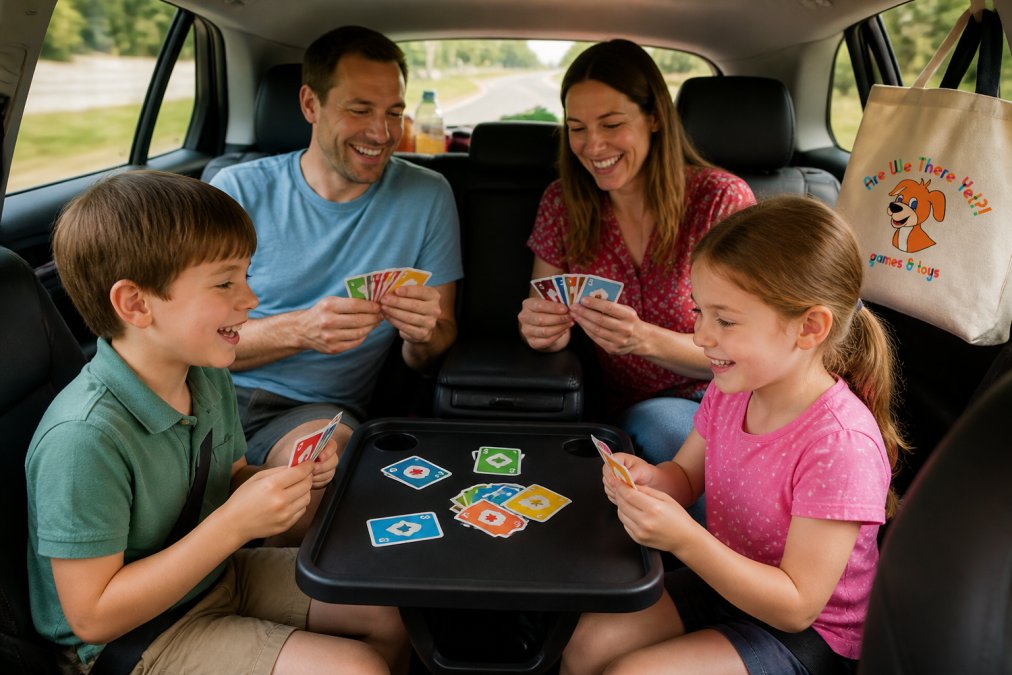
Card games win the road trip category for one reason: they pack flat. A single deck slides into a door pocket or a backpack side pouch, and there's no board to balance on a bumpy highway.
The trick is choosing games with simple rules and short rounds. Long setups fall apart the moment someone drops a card between the seats.
Go Poop!: The Silly Matching Game Kids Ask For Again and Again
Go Poop! is a matching card game built for 2 to 4 players ages 4 and up, and it's the one your kids will beg to play twice. Players collect sets of three cards: a magical creature, its favorite treat, and its colorful poop. It's a playful spin on Go Fish, and the silliness is the whole point. Potty humor lands with this age group every single time, and the matching mechanic keeps younger players in the game because the rules click fast. At $14.99, it's an easy add to the travel bag. You can grab it at Go Poop! Silly Card Game for Kids on the Go.

DIY vs. Store-Bought Card Games: What Actually Works
When considering DIY versus store-bought card games, the best choice often depends on the specific game and travel conditions.
- DIY wins for: scavenger hunts, bingo sheets, and printable word searches, where you control the difficulty
- Store-bought wins for: matching games and rule-based card games, where durability and consistent card sizes matter on a moving vehicle
- Skip DIY for: anything with small loose pieces that scatter when the car turns
Store-bought decks survive spills, sticky fingers, and being sat on. That matters when you're three hours from home.
Classic Road Trip Games That Never Get Old
Classic games stick around because they need zero equipment. No cards, no boards, nothing to lose. That makes them the fallback when the bag gets buried or the toddler has claimed everything within reach.
License Plate Game and Alphabet Challenge
The license plate game is a tally-based hunt: spot plates from as many states as you can and mark them off. The alphabet challenge flips it into a race, where players find each letter A through Z on signs, plates, or billboards.
Both work because they scale. A 4-year-old can shout out colors and letters (the CDC). A 10-year-old can track a full tally sheet and compete.
I Spy, 20 Questions, and Story Builders
I Spy needs no explanation and works from age three up (healthychildren.org). 20 Questions stretches older kids because it rewards sharp yes-or-no thinking. Story builders, where each person adds a sentence, are the sleeper hit: they keep going for as long as the kids stay interested, and the stories get ridiculous fast.
Road Trip Games for Toddlers: Simple, Mess-Free, and Tantrum-Proof
Road trip games for toddlers need three things: no loose pieces, no reading, and no waiting turns. Anything with a long setup invites a meltdown. But "toddler" covers a wide range of abilities, and the game that works at 18 months will bore a 3-year-old in ten minutes. Segment by developmental stage instead of treating toddlers as one group.
Ages 12 to 24 Months: Search and Point
At this stage, the game is really a shared attention exercise. Your child can point, label a few words, and track something you name. That's enough for:
- Color hunt: "Where's something red?" One color per round, no scorekeeping.
- Animal spotting: Cows, dogs, and birds out the window. Name it, make the sound, move on.
- Wheels and lights: Count trucks, buses, or traffic lights. Counting aloud is the whole activity.
No equipment, no turns, no losing. The parent does the narrating; the toddler does the pointing.
Ages 2 to 3: Matching and Simple Rules
This is where a first real game becomes possible, but only if every player acts at the same time or the "game" is a search. Two formats hold up:
- Chunky matching cards, simplified: Pull two or three pairs from a matching deck and play face-up. No hidden cards, no memory element yet. Add pairs as your child masters the set.
- Sticker scenes: A reusable sticker pad with a themed background (farm, road, ocean) lets a toddler place and re-place pieces without a rule set. Look for pads with thick, peelable vinyl stickers rather than paper ones, which tear on the first pull.
Ages 3 to 4: First Turn-Taking Games
Turn-taking arrives here, but keep rounds under two minutes. A matching card game with a simple collect-three mechanic works because the rules click fast and the silliness carries the attention. This is also the age where a small, durable card deck starts earning its place in the travel bag, it packs flat, wipes clean, and survives being sat on.
The Toddler Rules That Apply at Every Stage
- Keep the game in their hands. If you're holding the cards, you're the one playing.
- No loose small parts. Anything that can roll under the seat ends the game for good, and small parts are a choking hazard for kids under three.
- One game per 15-minute block. Toddlers disengage faster than parents expect, but they'll happily restart a favorite after a break.
- Skip the lap tray until age two. Before that, a tray is a projectile. Hand items directly instead.
How to Keep Kids Busy in the Car: Strategies Beyond Games
Knowing how to keep kids busy in the car comes down to rhythm, not entertainment volume. Kids don't need constant novelty. They need a predictable flow between active and quiet.
Try this structure for a long drive:
- Active game (card game or verbal game), 20 to 30 minutes
- Snack and stretch break
- Quiet activity (audio or printable), 20 to 30 minutes
- Repeat with a new game each cycle
| Phase | Activity Type | Duration | Best For |
|---|---|---|---|
| Kickoff | Card game | 20-30 min | Ages 4+ |
| Wind-down | Audio story | 20-30 min | All ages |
| Reset | Printable or sticker sheet | 15-20 min | Ages 3-8 |
| Free play | Verbal game (I Spy, 20 Questions) | 15 min | Ages 5+ |
The point is to alternate energy levels so nobody hits travel fatigue by hour two.
Printable Activities and Travel-Sized Board Games Worth Packing
Printables earn their spot because they're cheap, replaceable, and quiet. A stack of word searches, mazes, and bingo sheets costs almost nothing to print, and if one gets crumpled, you print another. The catch is choosing formats that work on a lap in a moving vehicle, a full-page crossword does not.
Printable Formats That Actually Work in a Car
- Road-trip bingo: A 4x4 or 5x5 grid of things to spot (rest stop, red truck, water tower, motorcycle). Laminate it or slide it into a page protector and hand over a dry-erase marker so the same sheet works for the whole trip.
- License plate tally sheets: A simple grid of all 50 states with checkboxes. Print one per kid so nobody argues over whose turn it is to mark.
- Mazes and dot-to-dots: Best for ages 4 to 8. Keep them single-page and large-print; fine detail is hard to trace on a bumpy road.
- Mad Libs-style fill-in stories: Print a blank story template and let kids supply the nouns and verbs. This doubles as a verbal game if you read the results aloud.
- Scavenger hunt checklists: Themed by region (mountains, farmland, city) so the list matches what's actually outside the window.
Print two copies of everything. The second copy is the backup for the one that gets spilled on, and it costs you nothing.
Travel-Sized Board Games: What Holds Up
Travel-sized board games are trickier than printables. Magnetic versions hold up better than standard sets because pieces stay put through turns and bumps, but they still need a flat surface. On a bumpy road, a card game usually beats a board game for pure practicality.
When a board game is worth packing:
- Magnetic travel sets of classics like checkers, chess, or tic-tac-toe. The board folds into a clamshell case and the pieces snap into place.
- Roll-and-write games that need only a die and a score sheet. No board to balance, no pieces to lose.
- Cooperative card games where players win or lose together, which cuts down on back-seat arguments.
Skip anything with loose magnetic pieces for kids under three. Small parts are a choking hazard, and a dropped piece under the seat ends the game for good.
Free DIY vs. Purchased: How to Budget Your Travel Kit
Most parents overspend on the wrong category. Here's the split that works:
| Category | Go Free (DIY/Printable) | Go Purchased |
|---|---|---|
| Scavenger hunts | Yes, you control difficulty and theme | Rarely worth buying |
| Bingo and tally sheets | Yes, print and laminate | Only if you want a pre-made themed set |
| Word searches and mazes | Yes, free generators online | Only for large-print or themed books |
| Matching card games | No, card size and durability matter | Yes, buy a durable deck |
| Rule-based card games | No, consistent card sizes matter | Yes, buy a durable deck |
| Board games | No, pieces scatter | Yes, magnetic travel sets only |
Store-bought decks survive spills, sticky fingers, and being sat on. That matters when you're three hours from home. Printables win everywhere the rules are yours to set.
Audio Entertainment and Quiet Activities for Independent Play
Audio is the most underrated screen-free tool for long drives. An audiobook or a story podcast lets one kid zone out while another plays a game, which matters when siblings need a break from each other.
Pair audio with a hands-on quiet activity and you get real independent play:
- Sticker books and reusable sticker scenes
- Water-reveal pads that only show color when wet
- Sketch pads with a single pencil (skip the full art kit)
- A small tin of magnetic tiles on a lap tray
The goal is a low-mess activity a child can run alone, so you're not refereeing from the front seat. This is also where a compact card game earns its keep: it packs down small, wipes clean, and gives kids a shared activity when the quiet time runs out.
Conclusion
Keeping everyone engaged without screens can be a challenge on long drives. A thoughtful selection of card games, printables, and audio entertainment can make a significant difference.
At Are We There Yet, we built our games for exactly this: portable screen-free card games designed by a traveling family, with free US shipping on every order. Start with Go Poop! for the giggles, then build your travel kit around it.
Frequently Asked Questions
What is the best game for a road trip?
The best road trip game depends on your kids' ages and attention spans. Card games like Go Poop! work well for ages 4 and up because they are portable, quick to learn, and encourage interaction. For older kids, the License Plate Game and Alphabet Challenge keep everyone scanning the scenery. Mixing a few game types, card games, verbal games, and scavenger hunts, prevents boredom and keeps the whole family engaged for hours.
How do you keep kids entertained on a long car ride without screens?
Rotate activities every 30 to 45 minutes to match attention spans. Start with an interactive verbal game like I Spy, then switch to a card game such as Go Poop!, follow with a printable scavenger hunt, and finish with an audio book or music. Pack each activity in a separate bag so kids have something new to open. Snacks and comfort items also help bridge the gaps between games.
What are the best card games for road trips?
Look for card games that are compact, easy to learn, and playable with 2 to 4 people. Go Poop! is a standout for ages 4 and up because it puts a silly twist on Go Fish with magical creatures and matching sets. Other good options include classic Go Fish, Uno, and memory matching games. Choose games with durable cards and a small box that fits in a seat-back pocket or carry-on.
Are screen free road trip games worth the investment?
Screen-free games can be a valuable investment for families. They encourage conversation, family bonding, and independent play, and can help reduce motion sickness by encouraging kids to look around. A quality card game, like Go Poop! at $14.99, offers reusable entertainment for many trips. Starting with one or two games and expanding your collection based on your children's enjoyment is a great approach.
Packing the right games takes ten minutes. Watching your kids actually enjoy the drive is worth every one of them. Get started with Are We There Yet and turn the next long haul into the part of the trip everyone looks forward to.


