

Melissa and Doug Alternatives: Best Screen-Free Games for Families
Table of Contents
- Why Parents Look for Melissa and Doug Alternatives
- Asmodee vs Gamewright for Families: Which Brand Delivers Better Value
- Best Travel Games for Kids That Actually Hold Attention
- Screen-Free Entertainment for Road Trips: Portable Options That Work
- What Makes a Game Worth the Investment Over Cheaper Alternatives
- How to Choose the Right Games for Your Kids' Ages and Interests
- Conclusion: Building Your Travel Game Collection
- Frequently Asked Questions
Last Updated: September 18, 2026
Why Parents Look for Melissa and Doug Alternatives
When you're packing for a six-hour road trip with kids, you need games that actually work. Melissa and Doug makes solid toys, but many parents find themselves looking for options that fit their specific travel needs, budget, or family style. The search for Melissa and Doug alternatives isn't about those toys being bad, it's about finding the right fit for your family's journey.
Parents seek alternatives for several reasons. Some want lighter, more compact options that fit in a carry-on. Others prefer games that work for a wider age range without requiring constant adult supervision. Budget matters too. And some families simply want variety so their kids aren't playing the same three games on every trip.
At Are We There Yet, we offer screen-free games that transform long drives from "are we there yet?" complaints into actual family bonding time. The good news is the market has expanded dramatically. You're not limited to one brand anymore, there are dozens of quality options designed specifically for travel and portable play.
Asmodee vs Gamewright for Families: Which Brand Delivers Better Value
The two biggest players in portable family games are Asmodee and Gamewright, and they take completely different approaches to both gameplay and material standards. Understanding the difference helps you pick the right brand for your needs, especially when safety and durability matter.
Gamewright focuses on games that work for multiple ages and skill levels. Their designs emphasize quick setup, simple rules, and genuine fun without requiring a rulebook PhD. Games like Sushi Go! and Hoot Owl Hoot work for kids as young as four and keep older siblings engaged. The company deliberately keeps games compact and lightweight, perfect for travel.
Asmodee owns multiple game publishers and offers more variety across different game types. They have strategic games, cooperative games, party games, and everything in between. This breadth means you're more likely to find exactly what you're looking for. However, Asmodee's material standards vary by publisher and title. Some lines use high-quality components; others source more economically. You'll need to check individual product specifications rather than trusting a brand umbrella.
For families traveling, Gamewright's consistency wins on gameplay. You know what you're getting: simple, engaging, and portable. Asmodee's strength is depth and variety, but that variety comes with inconsistent material sourcing. Neither is objectively better; it depends on whether you value simplicity or selection and strategic depth.
When evaluating any alternative brand, look for certifications like ASTM F963-17 (toy safety standard) and EN 71 (European safety standard). Brands that list these on their websites or packaging are signaling commitment to third-party verification.
Best Travel Games for Kids That Actually Hold Attention
The real test of a travel game isn't whether it's fun at home. It's whether your kids will actually play it on hour four of a seven-hour drive when they're tired and bored.
Games that hold attention share specific traits: they don't require constant adult supervision, they have natural stopping points (so you're not trapped in a three-hour game), and they work with the disruptions that come with travel. A game that needs a flat table won't work on a lap tray. A game with fifty tiny pieces won't survive a bumpy road.
Iota is a pattern-matching card game that works for ages six and up, requires nothing but the cards, and plays in fifteen minutes. Kids can stop and start without losing progress. Hoot Owl Hoot works similarly for younger kids, cooperative, simple rules, natural endpoint.
The best travel games also have replay value. Your kids will play the same game multiple times on a long trip. Games with randomized elements (shuffled cards, dice rolls) stay fresh longer than games with fixed setups.
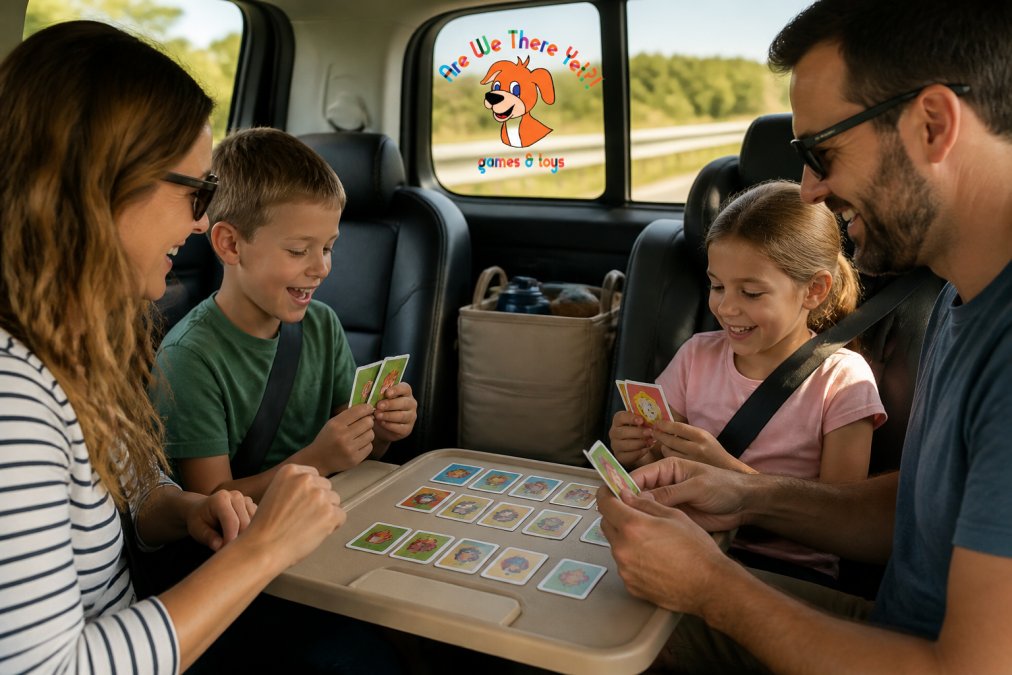
Are We There Yet's collection is built around this exact principle. Every game in our lineup is designed by a traveling family who tested these games on actual road trips. We know what works because we've lived it.
Screen-Free Entertainment for Road Trips: Portable Options That Work
Screen-free doesn't mean boring. It means intentional. It means your kids are building problem-solving skills, practicing social interaction, and actually enjoying time with their family instead of zoning into a device.
The portable options fall into a few categories. Card games are the lightest and most flexible. Board games designed for travel (smaller boards, fewer pieces) offer more structure. Dice games work anywhere. Puzzle games and brain teasers require nothing but paper and a pen.
The key is rotation. Don't pack one game and expect it to sustain a twelve-hour drive. Pack four or five options so kids can switch when they get bored. A mix of cooperative games (where kids work together), competitive games (where they play against each other), and solo puzzle games keeps variety high.
Magnetic games are worth considering if you have kids aged seven and up. Travel chess, travel checkers, and magnetic Scrabble all work on tray tables and car seats. They're heavier than card games but still reasonable for travel.
What Makes a Game Worth the Investment Over Cheaper Alternatives
You can buy a deck of cards for two dollars. You can grab a basic game at Target for eight dollars. Why would anyone spend fifteen, twenty, or thirty dollars on a travel game?
Quality matters in ways that aren't obvious until you're using the game. Cheap cards wear out fast, corners bend, the finish scuffs, they become unplayable within a few trips. Quality card stock lasts for years. The same applies to game boards, pieces, and boxes. A game you'll play hundreds of times across multiple years justifies a higher upfront cost.
Design quality also affects playability. A well-designed game has intuitive rules that kids understand quickly. A poorly designed game requires constant rule clarification and adult intervention. That's exhausting on a road trip when you're also driving.
Durability is the hidden factor. Games designed for travel use materials and construction that handle being tossed in a bag, played on bumpy surfaces, and used repeatedly. A game that falls apart after three trips isn't a bargain, it's a waste.
The best investment games are ones you'll actually use repeatedly. If a game sits in your closet, price doesn't matter. If a game gets played on every road trip for five years, a higher initial cost makes financial sense.
How to Choose the Right Games for Your Kids' Ages and Interests
Age recommendations exist for a reason, but they're not absolute. A five-year-old who loves patterns might dominate at Iota. A nine-year-old who dislikes competition might hate a game that's technically age-appropriate. The key is matching games not just to age, but to the specific developmental milestones your child is working through.
For ages 4-5 (Early Pattern Recognition & Turn-Taking): Children at this stage are developing the ability to recognize visual patterns and wait for their turn without adult prompting. Games like Hoot Owl Hoot (cooperative, no turn-taking pressure) and Candy Land (simple color matching) build these foundations. Avoid games with simultaneous play or hidden information; they require impulse control that hasn't fully developed yet.
For ages 6-7 (Rule Following & Short-Term Strategy): Kids begin understanding "if-then" logic and can follow a sequence of rules without constant reminders. This is when card games like Sushi Go! and Iota become accessible. These games introduce basic strategy (choosing which card to play) without overwhelming working memory. Games at this level should have natural endpoints within 15-20 minutes; longer games cause frustration.
For ages 8-10 (Competitive Play & Risk Assessment): Children develop the ability to think ahead one or two moves and tolerate losing without emotional dysregulation. This is when games with negotiation, trading, or bluffing mechanics become engaging. Games like Ticket to Ride (simplified versions) and Splendor introduce resource management.
Conclusion: Building Your Travel Game Collection
The transition from "we need something for the drive" to "we have a collection of games our family loves" happens gradually. You start with one or two options, discover what works for your family, and expand from there.
Frequently Asked Questions
What are the best screen-free entertainment options for road trips besides Melissa and Doug?
Asmodee and Gamewright both offer excellent alternatives with different strengths. The best choice depends on your children's ages and how long your trip is.
How do I choose between Asmodee and Gamewright games for my family?
Asmodee games tend to have more complex rules and deeper strategy. Gamewright games emphasize quick rounds and simpler mechanics. Consider your family's play style.
Are there portable games that work for both 4-year-olds and 10-year-olds?
Yes. Look for games with flexible rules or difficulty levels that scale by age. Card-based games often work across ages since you can adjust hand sizes or play objectives. When shopping, check if the game offers variant rules for different ages, this feature saves you from buying separate games for each child.
What should I look for to make sure a travel game is actually durable and worth buying?
Check for thick cardstock, reinforced corners, and secure box construction. Read reviews specifically mentioning durability after travel use. Avoid games with small, easy-to-lose pieces if you're flying, loose components in carry-ons are frustrating. Also consider whether pieces are replaceable if something breaks mid-trip.
| Game Type | Best For | Setup Time | Typical Duration |
|---|---|---|---|
| Card games | All ages, maximum portability | 2 minutes | 15-20 minutes |
| Cooperative games | Mixed ages, family bonding | 5 minutes | 20-30 minutes |
| Dice games | Ages 5+, quick entertainment | 1 minute | 10-15 minutes |
| Travel board games | Ages 6+, more structure | 5-10 minutes | 25-40 minutes |
| Puzzle games | Ages 7+, solo or pairs | 2 minutes | Variable |


