

Travel Games for Long Car Rides: 7 Screen-Free Ideas
Table of Contents
- Why Screen-Free Travel Games Beat Tablets on Long Drives
- How to Keep Kids Busy in the Car Without Screens
- Best Card Games for Road Trips (Ages 4 and Up)
- Road Trip Games for Toddlers (Ages 3 to 5)
- Printable Activities, Scavenger Hunts, and License Plate Games
- Audio Entertainment and Quiet Independent Play Options
- Travel Games for Long Car Rides: A Quick Packing and Cleanup Plan
- Conclusion
- Frequently Asked Questions
Last Updated: September 14, 2026
Why Screen-Free Travel Games Beat Tablets on Long Drives
Travel games for long car rides solve a problem tablets only mask: a screen keeps a child quiet but doesn't keep a family connected. This guide from Are We There Yet breaks down seven screen-free ideas that hold up mile after mile.
The tablet works, and that's the problem: it becomes the default, and the ride turns into seven silent hours of separate people in the same vehicle. Screen-free travel games ask more upfront but pay it back in engagement, conversation, and kids who arrive without a glazed look.
The American Academy of Pediatrics has long advised that unstructured, interactive play supports language and social development in ways passive screen time cannot replicate, which is why pediatricians routinely suggest the AAP's family media guidance when parents ask how to handle long trips.
Below, we'll show you how to build a car activity kit, which games work by age, and how to pack and clean up. The seven ideas we cover survive real road trips, not store displays.
How to Keep Kids Busy in the Car Without Screens
Keeping kids busy without screens comes down to two moves: prepare a kit before you leave, and rotate what's available before boredom sets in. Skip the rotation and the game that thrilled a child at mile 10 is "so boring" by mile 60.
Set Up a Car Activity Kit Before You Leave
A car activity kit is a small, self-contained bag of games and activities sized for the back seat. Build one per child so nobody negotiates over shared pieces.
- One card game or deck per child
- A small clipboard and a few pencils
- Two or three printable sheets, swapped out mid-trip
- A snack pouch and a refillable water bottle
- A small pouch for loose pieces so nothing rolls under the seat
The container matters as much as the contents: a soft-sided bag with a zipper beats a hard box, which becomes a projectile the first time you brake hard.

Rotate Activities Every 30 to 45 Minutes
Rotation is the highest-use habit for a long drive. Swap the active activity every 30 to 45 minutes, before frustration sets in.
| Time Block | Activity Type | Why It Works |
|---|---|---|
| 0-45 min | Card game or verbal game | High energy, kids are fresh |
| 45-90 min | Printable or worksheet | Quieter, lets energy settle |
| 90-135 min | Scavenger hunt or bingo | Re-engages attention with the window view |
| 135-180 min | Audiobook or quiet solo play | Wind-down before the next stop |
This rhythm prevents travel fatigue from stacking up.
Best Card Games for Road Trips (Ages 4 and Up)
The best card games for road trips are compact, mess-free, and playable in a moving vehicle. Cards beat boards in a car for one obvious reason: nothing to balance.
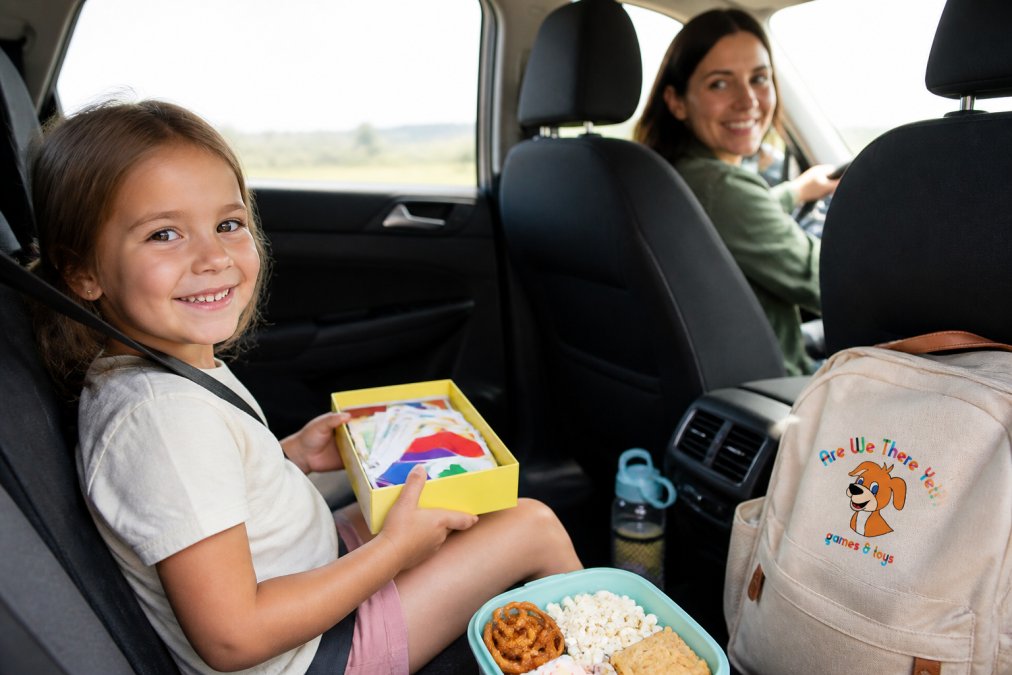
Go Poop! Silly Card Game for Kids on the Go
Go Poop! is a matching card game for 2 to 4 players ages 4 and up that twists classic Go Fish. Players collect sets of three cards: a magical creature, its favorite treat, and its colorful poop. Special potty cards keep younger kids laughing instead of losing interest.
It costs $14.99 with free US shipping, and it's the game we reach for first on long drives because the rules are simple enough for a 4-year-old to follow after one round. You can find it here: Go Poop! Silly Card Game for Kids on the Go.
Classic Card Games That Work in a Moving Car
Not every card game survives a car ride. Loose piles and tiny pieces become a cleanup nightmare at 65 miles per hour.
- Go Fish: Simple matching, minimal table space, works for ages 4 and up
- Uno-style matching games: Fast rounds, easy to pause and resume
- Old Maid: No reading required, good for pre-readers
- Crazy Eights: Slightly more strategy, better for ages 6 and up
The difference comes down to footprint: if it needs a flat surface wider than a lap, it's a table game, not a car game.
Road Trip Games for Toddlers (Ages 3 to 5)
Road trip games for toddlers need to work without reading, fine motor precision, or long attention spans, which rules out most card games and printables. Between ages 3 and 5, children build receptive language faster than expressive, so they follow spoken prompts long before they can read (the CDC). Games built on pointing, calling out, and simple matching hold up; games requiring held cards, score tracking, or turn order usually don't.
What Actually Works at This Age
- Color and shape spotting. Call out a color ("find something red") or a shape ("find a circle") and let the child point. No materials, no rules to memorize, and it scales down to a 3-year-old who is still learning color names.
- Sound hunt. Ask the child to listen for a specific sound, a truck horn, a bird, a siren, and raise a hand when they hear it. This works when the window view is boring (long highway stretches, construction zones) because it shifts attention to audio.
- Picture-based I Spy. Standard I Spy fails for pre-readers because the adult picks something the child can't name. Flip it: let the toddler pick, and you guess. The toddler stays in control, which is the single biggest predictor of whether a game survives past mile 20.
- Sing-along and call-and-response songs. "The Wheels on the Bus," "Old MacDonald," and similar songs with predictable refrains let a toddler participate without needing to know the words. This is also the easiest game to run from the driver's seat.
- Magnetic drawing boards. A small magnetic doodle board with a attached stylus is the one "toy" that reliably works for this age in a moving car. Nothing to lose, nothing to spill, and it can be wiped and reused for the whole trip.
What to Skip
Most card games, printed worksheets, and anything with loose pieces are a poor fit before age 5. A dropped card under the seat won't be forgotten, and retrieval is unsafe and disruptive. The same goes for tiny stickers and any game needing a flat surface wider than a lap.
Handing a toddler a game designed for a 6-year-old won't hold, and the meltdown that follows isn't the child's fault. Match the game to the developmental stage, not the age on the box.
A Toddler-Specific Rotation
Toddlers do better with shorter blocks: roughly 15 to 20 minutes per activity, with a snack or song break between. Rotate a verbal game (color spotting), a quiet activity (magnetic board), a song, then a rest period, shorter than the 30-to-45-minute rotation for ages 6 and up, because a 3-year-old's attention span is measured in minutes.
Printable Activities, Scavenger Hunts, and License Plate Games
Printable activities are the cheapest, most flexible category of travel games for long car rides because you print exactly what fits your kids' ages. A clipboard turns any back seat into a desk. The trade-off: printables are consumable, so the question is how many to bring and where to get them without paying per download.
Free vs. Paid Printables: What to Expect
The DIY route is free and often better: build a custom bingo card in a word processor in about ten minutes with clip art or text, and tune the difficulty, a 4-year-old gets six large pictures, a 9-year-old gets a 5x5 grid with harder items like "a windmill" or "a car with a roof rack."
Commercial packs run a few dollars per download and bundle 10 to 30 themed sheets, saving time with consistent quality, but most aren't age-differentiated, so you print sheets your kids can't use.
A workable middle path: print two or three free sheets per child from a general search, then build one custom bingo card per child in a word processor. That combination covers variety without spending anything.
Visual Scavenger Hunts and Bingo Cards
A visual scavenger hunt asks kids to spot items out the window and mark them off; bingo cards work the same way. The key design decision is item frequency, if half the items are rare (a hot air balloon, a limousine), the game stalls and kids disengage.
A balanced card mixes common and uncommon items:
- Common (expect to see within 30 minutes): a red car, a truck, a bridge, a road sign with a number, a motorcycle
- Uncommon (expect to see within 2 hours): a red barn, a farm animal, a car with a roof rack, a license plate from another state, a windmill
- Rare (bonus items): a limousine, a car towing a boat, a police car with lights on
For pre-readers, use picture-based cards. For older kids, add a tally column so they can track how many of each item they spot, and add a small prize for the first to fill a row. The prize doesn't need to be a purchase, first pick of snacks at the next stop works.
License Plate Game and Alphabet Challenge
The license plate game is the classic for a reason: it needs zero materials beyond a printed list of states, and it can stretch across an entire trip. Print the list alphabetically so kids find states quickly, and laminate it or use a page protector so it survives multiple trips.
The alphabet challenge is the verbal cousin: players find something outside the car starting with each letter, A through Z, in order. It works for ages 5 and up. Q, X, and Z are the sticking points, a common house rule allows any word containing the letter ("exit" for X).
A Note on Clipboards and Cleanup
A standard letter-size clipboard fits a lap without blocking the seatbelt and gives kids a hard surface. The downside is paper clutter. The fix: one clipboard per child, one sheet at a time, and used sheets into a "done" pouch instead of onto the floor. Empty the pouch into a trash bag at each stop, and the back seat won't become a paper pile by day two.
Audio Entertainment and Quiet Independent Play Options
Audio entertainment is the most underrated screen-free option for long drives. An audiobook or family-friendly podcast holds attention without requiring anyone's hands or eyes.
For quiet independent play, give each child a solo option: a sketchbook, sticker book, or single-player puzzle sheet. It gives kids a break from constant group interaction, and parents a break too.
The National Literacy Trust's research on audiobooks and reading engagement found that listening to audiobooks supports vocabulary and comprehension in children, which makes them a genuinely educational choice, not just a way to pass time.
Travel Games for Long Car Rides: A Quick Packing and Cleanup Plan
A packing and cleanup routine keeps travel games for long car rides from becoming a mess of loose cards and crumpled paper by day two. Ten minutes at each stop saves an hour of frustration.
Before you leave:
- Build one kit per child
- Print 3 to 5 activity sheets per child
- Download an audiobook or two
- Pack a small pouch for loose pieces
At each stop:
- Collect loose cards back into their boxes
- Trash used worksheets
- Restock snacks and water
- Swap in one fresh activity for the next leg
At the destination:
- Empty and air out each kit
- Restock printables for the return trip
- Wipe down clipboards and card boxes
Post-trip cleanup is the step everyone skips, and it determines whether your kit is ready for the next trip or a pile of random pieces in the trunk.
Conclusion
The hardest part of a long drive isn't the distance, it's keeping everyone engaged without defaulting to a screen. Are We There Yet builds screen-free card games designed by a traveling family for exactly this problem, with portable games that fit in a carry-on and free US shipping on every order. If you want a game that survives a six-hour drive, start with Go Poop! and build your kit from there. Get started with Are We There Yet and make the next long car ride one your kids look forward to.
Frequently Asked Questions
What is the best game for a road trip with kids?
The best travel games for long car rides are portable, mess-free, and easy to learn in under five minutes. Card games like Go Poop! work well because they fit in a carry-on, need no loose pieces, and suit ages 4 and up. Pair a card game with a printable scavenger hunt so kids can switch activities when attention drops. Rotating between two or three options every 30 to 45 minutes keeps engagement higher than relying on one game for the whole drive.
How do you keep a toddler entertained on a long car ride?
Road trip games for toddlers need to be simple, visual, and hands-on. Try color-spotting games ('find something red'), felt boards, chunky board books, and sing-along songs. Snacks and a comfort item help too. Toddlers rarely stay with one activity past 15 minutes, so pack four or five small options and rotate them. Avoid games with tiny pieces that get dropped between seats. A parent sitting in back for short stretches can reset the mood fast.
What are the best card games for road trips that work in a moving car?
Look for card games with no loose parts, no writing, and rules kids can hold in their head. Matching games, Go Fish variants, and guessing games all work because players only handle cards in their lap or a tray. Skip anything with dice, tiny tokens, or a board. A good pick for ages 4 and up is Go Poop!, a matching game where players collect sets of three cards, which keeps hands busy without needing a flat surface.
What is the 3-3-3 rule for a road trip?
The 3-3-3 rule is a pacing guideline: stop every 3 hours, take a 30-minute break, and plan to arrive by 3 p.m. if you can. For families, it doubles as an activity schedule. Use each 3-hour stretch for a different type of travel game, then swap to something new after the break. The 30-minute stop lets kids run, use the bathroom, and reset. Arriving before late afternoon reduces meltdowns and travel fatigue for everyone.


