

Are Educational Card Games Worth the Investment? 6 Factors
Last Updated: November 7, 2026
Quick Summary
Yes, educational card games are worth the investment for most families when you measure cost per play rather than sticker price. A deck played weekly for a year costs pennies per session, while a cheap game played twice costs a lot per session no matter its price.
- Divide what you pay by how many times your family actually plays to find cost per play.
- Frequent, short sessions beat occasional long ones for retention, and adult scaffolding amplifies learning.
- Match the deck to the child's stage, not the box, since age ranges are a starting point.
- Cards win for road trips because they pack flat, have no loose pieces, and reset in seconds.
- Skip the purchase if the game will not get played at least monthly.
Table of Contents
- The Real Cost of Educational Card Games vs. Apps and Workbooks
- What the Evidence Says About Learning Through Play
- How Educational Card Games for Kids Build Skills That Last
- Best Educational Games for 7 Year Olds and How to Match Age to Deck
- Educational Games for Road Trips: What Actually Survives the Back Seat
- Screen-Free Travel Games for Kids: Durability and Long-Term Value
- Choosing Games That Fit Your Family and Your Carry-On
- Are Educational Card Games Worth It? A Decision Framework
- Frequently Asked Questions
The Real Cost of Educational Card Games vs. Apps and Workbooks
Are educational card games worth the investment? For most families, yes, but only if you measure cost per play rather than sticker price. A deck that costs more up front and gets played for years usually beats a cheap game that sits in a drawer. At Are We There Yet, we built our screen-free card games around exactly that idea: small, sturdy, and made to be played again and again.
Purchase Price, Replay Value, and Cost Per Play
The math is simple. Divide what you pay by how many times your family actually plays. A game played weekly for a year costs pennies per session. A game played twice costs a lot per session, no matter how cheap it was.
Three things drive replay value:
- Simple rules that kids can teach a sibling
- Short rounds so nobody loses focus
- Enough variety to feel new each time
The American Academy of Pediatrics' guidance on play notes that play is central to healthy child development, which makes repeat play more than just entertainment.
Where Free Alternatives Fit In
Free options have a real place. Library game collections, printable card sets, and borrowed decks let you test what your kids enjoy before spending anything.
But free has hidden costs. Printable sets wear out fast. Borrowed games go back. Apps are free because they sell attention, and many parents would rather not trade screen time for savings. If you want a deeper look at whether pricier games pay off, read are expensive travel card games worth it.
What the Evidence Says About Learning Through Play
Learning through play is the practice of building skills through games and open activity rather than drills. The evidence base is solid on the big picture: play supports language, problem-solving, and social skills in young children.
The harder question is whether a specific box labeled "educational" delivers measurable learning. Here the evidence is thinner and more mixed than marketing suggests. Most studies of educational games are small, short-term, and run in classrooms or labs rather than living rooms. They often measure engagement or immediate recall rather than durable skill gains. A common pattern is that gains fade when the game stops being played, which makes replay frequency, not the label, the variable that matters most.
What the research does support is narrower and more useful:
- Frequent, short sessions beat occasional long ones for retention.
- Adult scaffolding, asking questions, modeling strategy, naming what the child just did, amplifies learning more than the game alone.
- Games with clear mechanics (counting, matching, planning) show clearer skill links than open-ended "fun" decks.
- Transfer is limited: a counting game improves counting, but it will not automatically improve reading.
That last point is the practical takeaway. "Educational" on a box means little on its own. What matters is how the game works and how often it gets to the table. A deck that makes kids count, match, plan, and talk will teach more than a flashcard set used once, but only if it is played repeatedly and with some adult involvement.
Watch out: treating a single game as a curriculum substitute. The evidence supports games as one tool among many, not as a replacement for direct instruction or free play.
How Educational Card Games for Kids Build Skills That Last
Educational card games for kids build skills through repetition disguised as fun. Kids count cards, track turns, and negotiate rules without noticing they are practicing.
Critical Thinking, Math, and Literacy in One Deck
A good deck does several jobs at once:
- Math: counting sets, comparing totals, tracking what is left
- Literacy: reading simple rules, naming cards out loud
- Reasoning: deciding when to hold a card and when to play it
- Social skills: taking turns, losing gracefully, helping a younger player
That overlap is the real value. One small box covers several learning goals at once.
Best Educational Games for 7 Year Olds and How to Match Age to Deck
The best educational games for 7 year olds are the ones a child can almost run alone. At that age, kids want independence more than challenge, so the right deck is one they can set up, teach a sibling, and finish without an adult hovering.
Match the deck to the child, not the box. Age ranges on packaging are a starting point, not a guarantee. Use this framework to line up a game with a learner's stage, skill level, and goal:
| Learner stage | What they need | Game features to look for | Example skill goal |
|---|---|---|---|
| Ages 4-5 | Matching, sorting, memory; no reading required | Large cards, picture-only rules, short rounds | Recognition, turn-taking |
| Ages 6-8 | Simple set collection with a light strategy twist | One or two rule cards, clear win condition | Counting, comparing, planning |
| Ages 9-12 | Real decisions, bonus cards, light negotiation | Variable setup, multiple paths to win | Strategy, reasoning, sportsmanship |
| Mixed ages | Siblings playing together | Handicap or role cards, scalable rules | Social skills, mentoring |
Three questions sharpen the match:
- What is the specific goal? Counting, reading fluency, planning, and social skills point to different mechanics. A memory deck builds recognition; a set-collection deck builds comparison and planning.
- Can the child run it alone? If not, look for simpler rules or plan to play alongside them for the first few sessions.
- Will it still fit in six months? A deck that is too easy gets abandoned; one with a light strategy layer grows with the child.
Our Go Poop! deck is built for this range. It plays like Go Fish with magical creatures, treats, and poops, for 2-4 players ages 4 and up. Younger kids can sort or memory-match the cards, while older kids use the Potty Cards to try real strategy. It costs $14.99, and if you want more age-specific picks, see travel games for 8 year olds.
Watch out: buying to the top of a child's age range. A game pitched two years up often frustrates the child and ends up in the drawer.
Educational Games for Road Trips: What Actually Survives the Back Seat
Educational games for road trips need three things: no loose pieces, no reading in dim light, and rounds short enough for a bumpy highway.
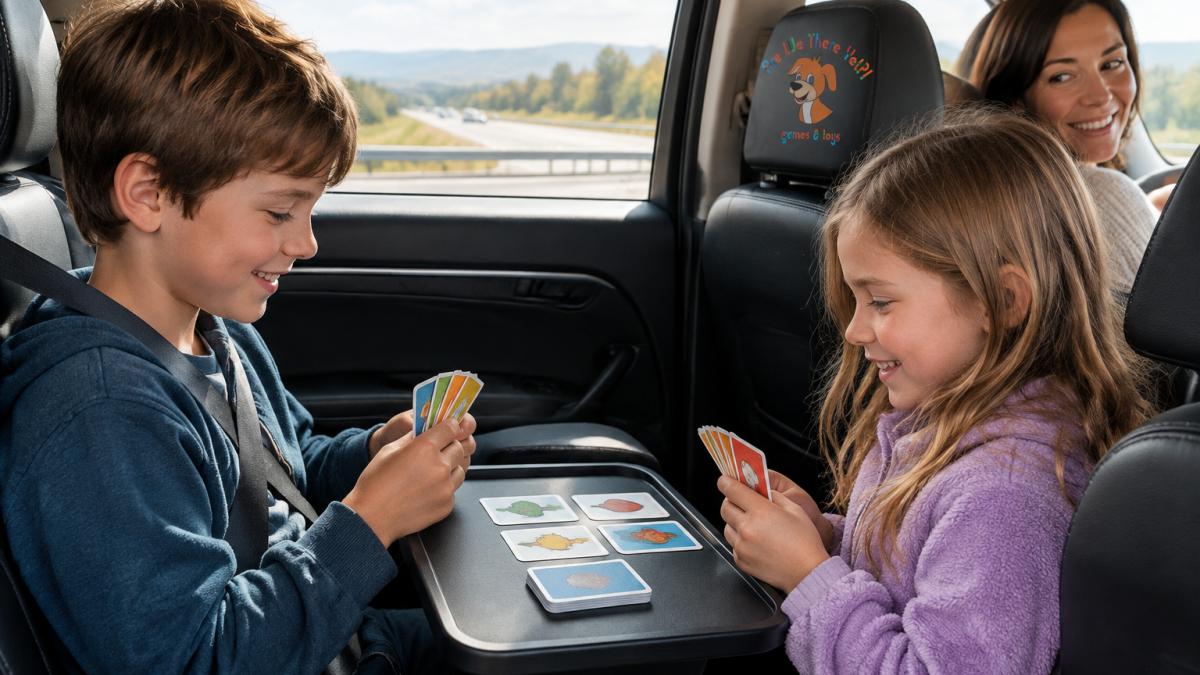
What fails in the car? Anything with tiny tokens, score pads, or a board. Cards win because they pack flat and reset in seconds. For more screen-free ideas, browse educational road trip games for kids.
Screen-Free Travel Games for Kids: Durability and Long-Term Value
Screen-free travel games for kids earn their keep through durability. A deck that survives a few trips a year will outlast three cheap sets that split at the corners.
Check these before you buy:
- Cards with a wipe-clean or linen finish
- A box that closes firmly
- Rules printed on a single card
- A size that fits a seat pocket
Watch out: thin cards and flimsy boxes are the two most common reasons a travel game dies early.
Choosing Games That Fit Your Family and Your Carry-On
Fit matters as much as fun. A great game left at home helps nobody. Measure your personal item or carry-on pocket before you shop, then check the box dimensions. For a deeper packing guide, see travel games that fit in carry-on.
Quick fit check:
- Car trips: any deck size works
- Flights: look for a box under roughly the size of a paperback
- Restaurants and waiting rooms: small decks with short rounds
Are Educational Card Games Worth It? A Decision Framework
Use this framework before you buy. It takes about two minutes and saves a lot of drawer clutter.
| Question | If Yes | If No |
|---|---|---|
| Will it get played at least monthly? | Worth the price | Skip it |
| Can a child run it with little help? | Strong buy | Look for simpler rules |
| Does it pack flat for travel? | Good travel pick | Keep it home |
| Does it cover more than one skill? | Better value | Narrow use |
| Will siblings of different ages play? | High replay value | Check age range |
If you want a concrete place to start, our Go Poop! silly card game for kids on the go is compact, easy to learn, and built for exactly this kind of play.

Most families waste money on games that get opened once. The fix is picking decks your kids can run alone, pack flat, and play in short rounds. Are We There Yet makes screen-free card games designed by a traveling family, sized for road trips and flights, with free US shipping on every order. Get started with Are We There Yet and turn the next long ride into a game your kids ask for again.
Frequently Asked Questions
Do educational games actually work?
Research on learning through play points to the value of guided, repeated play. A card game your child asks to play again is doing more work than a workbook they abandon. Look for games with simple rules and a strategic layer so the learning keeps pace as your child grows.
Are educational card games worth the cost compared with apps or workbooks?
A $14.99 deck that gets played regularly over time spreads its cost across many sessions. Workbooks are cheaper upfront but often get used once.
What skills can children learn from card games?
Card games build turn-taking, pattern recognition, and logical reasoning. Matching games like Go Poop! for ages 4 and up add set collection and simple strategy through special cards. Older kids practice planning and decision-making as they weigh which cards to hold. These are the same skills that show up in early math and literacy, just practiced through play instead of worksheets.
Are card games a good screen-free activity for road trips?
Compact card games work well on road trips because they need no batteries, no Wi-Fi, and no flat surface. A deck that fits in a carry-on pocket and sets up in under a minute keeps kids engaged during long stretches. Look for games with no reading required so younger players can join, and durable cards that survive being shuffled in a moving car.


