

Are Expensive Travel Card Games Worth It?
Table of Contents
- What Makes a Travel Card Game Worth the Price
- Best Card Games for Road Trips: What Sets Them Apart
- Best Travel Card Games for Kids: Age-Appropriate Value
- Travel-Sized Card Games: Portability vs. Play Experience
- Cheap vs. Premium Card Games: Cost Per Play Analysis
- Common Mistakes Parents Make When Buying Travel Games
- How to Know If a Travel Card Game Is Right for Your Family
- Frequently Asked Questions
Last Updated: October 17, 2026
What Makes a Travel Card Game Worth the Price
The question isn't whether you need a travel card game. It's whether you need the expensive one.
Parents spend anywhere from $5 to $40 on a single card game, and the gap between budget and premium options creates real confusion. Are We There Yet designed our games specifically for families like yours. The difference between a throwaway game and one that lasts years comes down to a few concrete factors: component quality, gameplay depth, portability, and replayability.

Here's what separates a game worth buying from one you'll regret: Does it hold up to actual use? Can kids play it without losing interest in 15 minutes? Will it survive being packed in a carry-on bag alongside snacks and forgotten juice boxes?
A travel card game's real value isn't the price tag. It's cost per play, how many times your family actually plays it before it breaks, gets lost, or gets boring. A $30 game played 100 times costs 30 cents per play. A $5 game played twice costs $2.50 per play. The expensive option wins.
Best Card Games for Road Trips: What Sets Them Apart
The best travel card games share three non-negotiable qualities: they're compact enough to fit in a backpack, simple enough that kids can learn in under five minutes, and engaging enough to hold attention for longer than a single bathroom break.
Road trips demand games that work without a table. That means cards that don't scatter when the car hits a bump, rules that don't require constant adult supervision, and gameplay that doesn't punish players for looking out the window. Games designed for travel anticipate these constraints. Games designed for living rooms don't.
Portability matters more than you think. A game that takes up half your carry-on bag isn't a travel game, it's luggage. The best ones compress to the size of a paperback. Component count also affects travel-friendliness. Games with 50+ cards, tokens, dice, and boards become management nightmares on a flight.
Gameplay depth separates games kids will play once from games they'll request repeatedly. A game that's too simple bores older kids. A game that's too complex frustrates younger ones. The sweet spot is a game with easy rules but strategic options, something that plays differently each time.
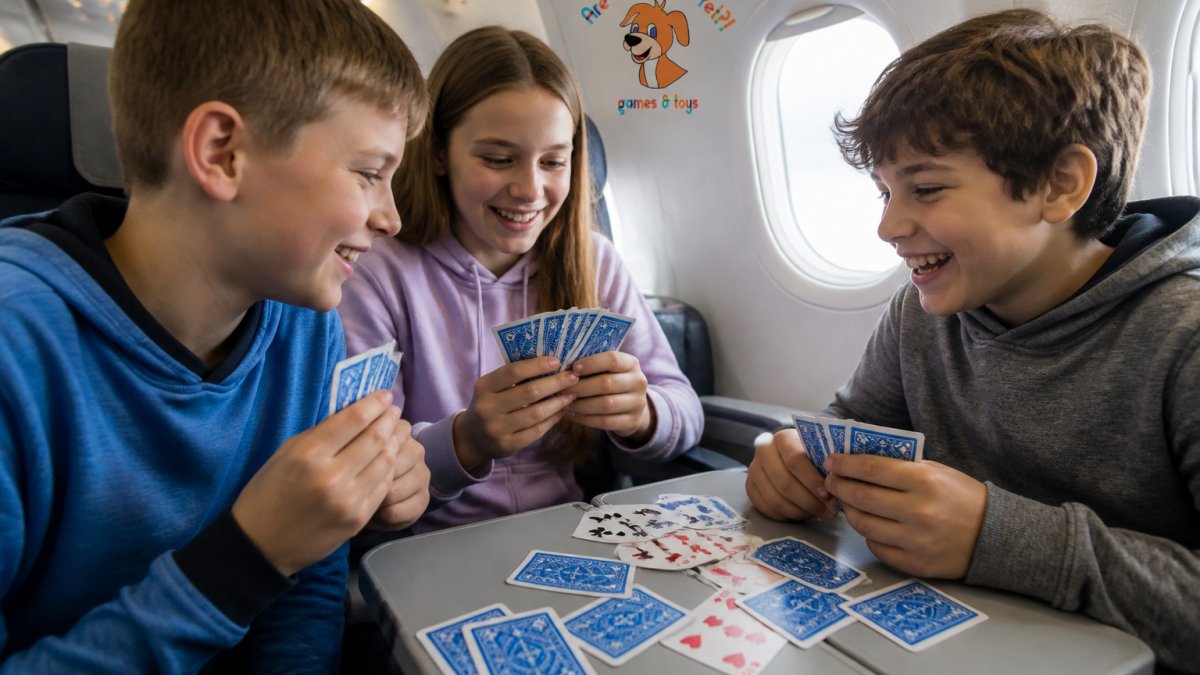
Best Travel Card Games for Kids: Age-Appropriate Value
Age matters more than you think when selecting travel card games. A game perfect for a 6-year-old frustrates a 10-year-old. A game that challenges older kids confuses younger ones.
For ages 4-6, look for games with simple matching rules, bright visuals, and short play sessions. These kids need immediate feedback and quick wins. Games with memory or pattern-matching mechanics work well. Go Poop! from Are We There Yet hits this age group perfectly, silly themes keep them engaged, and simple rules mean minimal setup.
Ages 7-9 want more strategy but still need clear rules. They're developing competitive instincts and can handle turn-based gameplay with real choices. Games where decisions matter, not just luck, keep this age engaged. They'll replay the same game multiple times if they feel like they could win differently next time.
Ages 10-12 can handle moderate complexity and longer play sessions. They appreciate games with theme, narrative, or strategic depth. They're also self-conscious about "baby games," so presentation matters. A game that looks cool gets played. A game that looks juvenile gets left behind.
Mixed-age families need games that scale. Some card games work for ages 4-12 if you adjust the rules or play cooperatively. Others have recommended age ranges that are real constraints, not suggestions. Don't force a 4-year-old into a game designed for 8-year-olds just because your older child wants to play.
Travel-Sized Card Games: Portability vs. Play Experience
Portability and play experience sit in constant tension. A game that's small enough to fit in a pocket might be too cramped to actually play. A game with beautiful components might weigh too much for a carry-on.
Game size comes down to card count, card dimensions, and packaging. A standard deck is about 2.5 by 3.5 inches. Smaller cards fit more in less space but can be harder for young kids to hold. Larger cards are easier to handle but take up more room.
Packaging affects portability more than actual card dimensions. A game in a full box takes up three times the space of the same game in a card deck box. Games in magnetic tins travel better than games in cardboard boxes. Games with no box at all, just cards in a rubber band, travel best but risk losing pieces.
Play experience suffers when portability gets prioritized too aggressively. Tiny cards frustrate young players. Minimal components make some games feel thin. A game that works perfectly on a table might be unplayable in a car seat or airplane seat.
Test portability before you buy. Can you shuffle the cards with one hand? Can a 5-year-old hold them without dropping them? Can you play on a seat tray without cards sliding everywhere? If you answer no to any of these, the game isn't truly travel-optimized.
Cheap vs. Premium Card Games: Cost Per Play Analysis
The price difference between a $5 game and a $30 game seems enormous until you calculate cost per play.
Cheap games often fail in three ways: components fall apart, rules are confusing, or gameplay gets boring fast. A $5 game might be played 5 times before it breaks or gets abandoned.
Component durability is the hidden cost of cheap games. Cheap cardstock bends easily, folds crease permanently, and ink fades. After two road trips, the cards look used. After four road trips, they're falling apart.
Go Poop! Silly Card Game for Kids on the Go →
Rule clarity separates games you'll actually play from games that sit unused. Cheap games often have poorly written rules, confusing setup, or unclear win conditions. Parents spend 20 minutes trying to understand how to play, kids lose interest, the game gets abandoned.
Replayability is where premium games justify their cost. A cheap game with one mechanic gets boring fast. A premium game with strategic depth, variable setup, or multiple play modes stays interesting. You'll play it 50 times instead of 5 times.
Consider resale value too. A premium game in good condition sells for 40-60% of the original price. A cheap game sells for nothing.
| Game Type | Typical Price | Expected Plays | Cost Per Play | Resale Value |
|---|---|---|---|---|
| Budget Card Game | $5-10 | 3-8 | $1.25-$3.33 | $0-1 |
| Mid-Range Card Game | $15-25 | 25-50 | $0.30-$1.00 | $6-12 |
| Premium Card Game | $25-40 | 75-150 | $0.17-$0.53 | $12-20 |
The mid-range and premium tiers deliver better value than the budget tier when you account for durability and replayability. That doesn't mean expensive is always better, it means the cheapest option is often the most expensive choice.
Common Mistakes Parents Make When Buying Travel Games
The first mistake is buying based on price alone. Parents see a $5 game and think they've found a bargain. They buy three of them instead of one $15 game. Six months later, all three have fallen apart and none of them are getting played.
The second mistake is buying without testing. You see a game online, the description sounds good, the reviews are positive, and you buy it without ever holding it or playing it. It arrives and your kids hate it. Or it's too complicated. Or it's too babyish.
The third mistake is buying one game for everyone. You have a 6-year-old and a 10-year-old. You buy one game designed for ages 8-10. The younger kid can't play it and gets frustrated. The older kid gets bored. Nobody plays it. You needed two different games, not one compromise game.
The fourth mistake is ignoring component quality. You buy a game without checking whether the cards are flimsy, whether the box will survive travel, or whether the pieces are small enough to lose. A game that falls apart after two trips isn't a bargain, it's wasted money.
The fifth mistake is assuming all travel games work in cars. Some games need a flat surface. Some need good lighting. Some have small pieces that get lost. Test your game in the actual travel environment before you rely on it for a long trip.
How to Know If a Travel Card Game Is Right for Your Family
Start by matching the game to your kids' ages and interests. A game that matches their current developmental level gets played. A game that's too advanced sits unused.
Consider your travel frequency and duration. A family that takes one annual road trip has different needs than a family that travels monthly. Frequent travelers need games that stay interesting after repeated plays.
Think about your kids' attention spans and frustration tolerance. Some kids focus on a single activity for 30 minutes. Others need variety every 10 minutes. Some kids handle losing gracefully.
Test gameplay with your specific kids before committing to regular use. Borrow a game from a friend if possible. Play it at home first. Does everyone actually enjoy it?
Budget for multiple games rather than one expensive game. Even the best game gets old after 50 plays.
Ask yourself the cost-per-play question: How many times will my family actually play this game? Divide the price by that number. If it's under 50 cents per play, it's worth buying.
At Are We There Yet, we designed our travel card games specifically to answer these questions. Go Poop! works for ages 4 and up, teaches in minutes, and survives being packed and repacked.
Buying travel card games for your family means balancing cost, durability, and actual play value. The most expensive option isn't always the best choice, but the cheapest option rarely is.
Frequently Asked Questions
Will a $15 travel card game really keep my kids entertained on a 6-hour flight?
It depends on the game's depth and your children's ages. Games designed for travel, like Go Poop! for younger kids, offer replayability that extends engagement beyond the first 20 minutes. The key is choosing games with simple setup but flexible rules, so kids can adjust difficulty as they play. Pair one travel card game with a second option to rotate through the flight and prevent fatigue with any single game.
How do you calculate cost per play for travel card games?
Divide the game's price by the estimated number of plays before it wears out or loses appeal. A $15 travel card game played 100 times over two years costs $0.15 per play. Compare this to a $5 budget game played only 20 times before boredom sets in ($0.25 per play). Premium games with deeper gameplay and higher replayability often deliver better value over time, especially for families who travel frequently or play games regularly at home.
What's the difference between cheap and premium travel card games?
Premium travel card games typically feature higher-quality card stock (more durable for repeated shuffling), thoughtful game design, and components that withstand travel wear. Budget options may use thinner cards or simpler mechanics. For families traveling frequently, premium games justify the cost through durability and longer engagement periods. Budget games work well for occasional trips or as backup options, but they may need replacement sooner.
Are travel-sized card games as fun as full-sized board games?
Yes, when chosen correctly. Travel card games sacrifice nothing in gameplay depth, they just eliminate bulky boards and pieces. Games like Go Poop! deliver social interaction and replayability in a compact format. The trade-off is component count, not fun. For flights, road trips, and downtime, compact card games often outperform larger games because they're easier to set up in tight spaces and don't require a full table.


