

Educational Road Trip Games for Kids: 7 Screen-Free Ideas
Table of Contents
- Why Educational Road Trip Games Beat Screens in the Backseat
- Educational Car Games for Kids: Learning Hidden in Play
- Car Games for Kids With No Supplies: Zero-Prep Fun
- Road Trip Games for Preschoolers: Simple, Short, and Silly
- Travel Card Games for Kids: Compact Learning That Fits in a Carry-On
- How to Adapt Road Trip Games for Different Ages and Abilities
- Driver Safety and Keeping the Fun in the Backseat
- Building a Low-Prep Road Trip Game Plan
- Frequently Asked Questions
Last Updated: October 18, 2026
Why Educational Road Trip Games Beat Screens in the Backseat
Educational road trip games for kids turn long drives into learning time without anyone noticing. At Are We There Yet, we've built our whole approach around this idea: the backseat is a classroom that happens to have wheels.
Here's the honest truth most guides skip: the best games need zero batteries, zero Wi-Fi, and zero setup. They run on what's already in the car.
Educational Car Games for Kids: Learning Hidden in Play
Educational car games for kids work because they disguise practice as play. A child spotting letters on signs is reading. A child counting out-of-state plates is skip counting. The learning happens, but nobody calls it homework.
I Spy and Observation Games That Build Vocabulary
I Spy is the simplest educational game in existence. One player says, "I spy with my little eye something green," and everyone else guesses. That's it.
The learning hides in the clues. Ask your child to describe the object by shape, color, size, or first letter. You're building vocabulary and observation skills with every round. For older kids, ban colors and force them to use adjectives instead.
License Plate Games and Route-Based Geography
The license plate game is a geography lesson that kids actually enjoy. Players watch for plates from different states and call them out. Keep a running list on paper or a phone note.
Here's where it gets smarter. Ask your child to name the state capital, or point out which direction that state sits from your route.
Car Games for Kids With No Supplies: Zero-Prep Fun
Car games for kids with no supplies are the ones you'll actually use. No bag to pack, no pieces to lose under the seat. Just voices and brains.
Verbal Games: 20 Questions, Would You Rather, and Word Charades
Verbal games are the workhorses of any long drive. They need nothing but players.
- 20 Questions: One player thinks of an object. Others ask yes-or-no questions to guess it. Great for logic and deduction.
- Would You Rather: Offer two silly choices ("Would you rather have a pet dragon or a pet dinosaur?"). Kids practice reasoning and opinion-building.
- Word Charades: Act out a word using only gestures while others guess. Perfect for wiggly passengers who need to move.
Counting and Memory Challenges for the Whole Family
Counting games teach math without a worksheet. Try these:
- Count red cars in ten minutes. Whoever gets closest wins.
- Count down from 100 by sevens as a family.
- Memory chain: each player adds an item to a growing list ("I packed a swimsuit, a snorkel, and...").
These challenges work for mixed ages because everyone can play at their own level.
Road Trip Games for Preschoolers: Simple, Short, and Silly
Road trip games for preschoolers need three things: simple rules, short rounds, and plenty of silly. A four-year-old loses interest fast, so keep each game under five minutes.
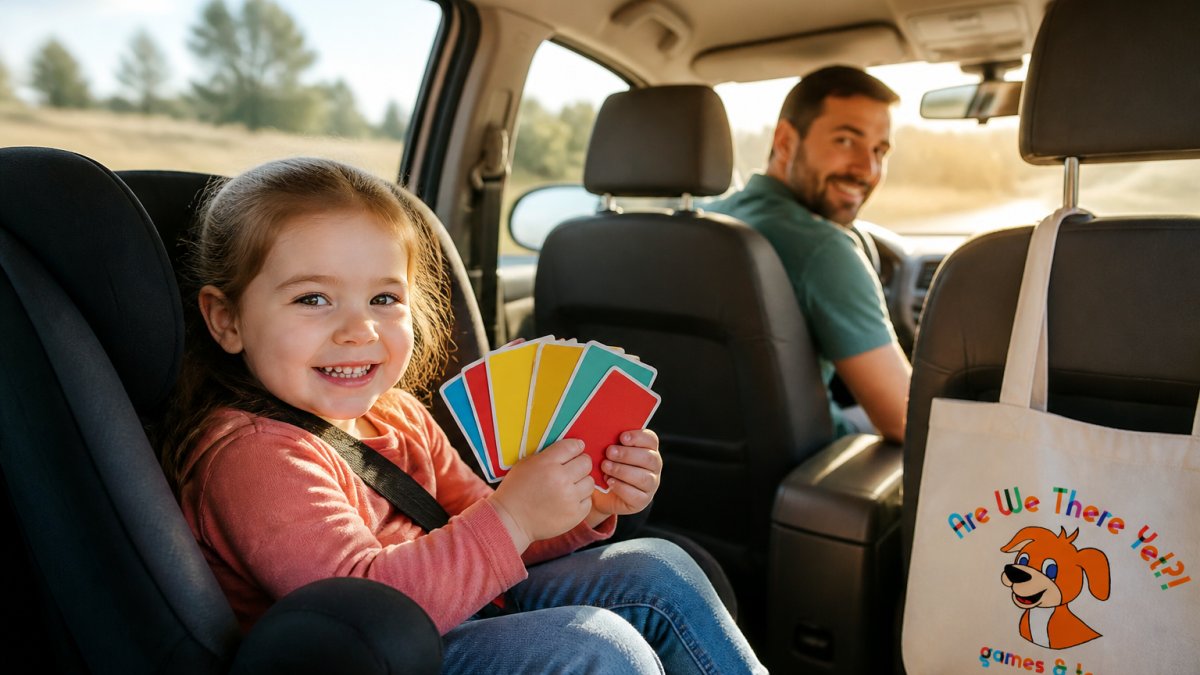
Try color spotting ("Who can find something blue?"), animal sounds ("What does a cow say?"), or a sing-along with silly lyrics. Our Go Poop! card game was built for exactly this age.

Travel Card Games for Kids: Compact Learning That Fits in a Carry-On
Travel card games for kids solve the packing problem. A deck of cards takes up less space than a tablet and never needs charging.
Look for games that teach something: matching, sorting, counting, or strategy. Our Go Poop! game, at $14.99, blends matching with light strategy through special Potty Cards that give players powers. It's designed for 2-4 players, so it works for siblings or the whole family.
When you shop, check three things:
- Age range on the box matches your youngest player
- Player count fits your family size
- Rule complexity stays simple enough to learn in the car
How to Adapt Road Trip Games for Different Ages and Abilities
One game can work across ages if you adjust the difficulty. This is where most families leave fun on the table. The trick is to change one variable at a time, the clue type, the round length, or the scoring, so the same game scales from a preschooler to a tween without anyone feeling babied or bored.
Preschoolers (ages 3-5): short rounds, concrete clues
Keep every round under five minutes and use clues a child can see or touch. For I Spy, limit clues to color and shape ("something round and red"). For counting games, count to five or ten, not to fifty. Let the child be the clue-giver as often as the guesser, that reversal is where the vocabulary practice happens.
Go Poop! Silly Card Game for Kids on the Go →
Early readers (ages 5-7): add letters and simple lists
This is the sweet spot for letter-based I Spy ("something that starts with B") and for the license plate game with a printed map. Keep a written list so the child practices letter recognition and handwriting without it feeling like a worksheet. Counting challenges can move to counting by twos or fives.
Older kids and tweens (ages 8-12): add constraints and scoring
Add a timer, ban colors in I Spy so players must use adjectives, or turn 20 Questions into a points system where a guess in five questions or fewer earns a bonus. The license plate game becomes a geography exercise: name the capital, or say which direction the state sits from your route. Memory-chain games can grow to ten or more items.
Mixed-age siblings: give each child a job
The simplest fix for a wide age gap is role assignment. The youngest is the spotter (calls out what they see), the middle child is the recorder (writes the list), and the oldest is the game captain (runs the round and keeps score). Everyone plays the same game at a level they can handle, and nobody is eliminated early.
Inclusive adaptations for sensory, visual, hearing, and learning needs
- Non-reading versions: Replace written clues with drawn or acted clues. Word Charades already works this way; I Spy can too if the clue-giver points and describes instead of naming a letter.
- Visual needs: Use large-print clue cards or describe objects by sound and texture rather than color alone. A backseat player with low vision can run the counting games by touch (counting buttons, snacks, or cards).
- Hearing needs: Pair every verbal game with a written or drawn version so a child with hearing loss can read the clue or watch the gesture. Seat the game captain where everyone can see their hands.
Driver Safety and Keeping the Fun in the Backseat
The driver stays out of the game. That's the rule. Any game that pulls the driver's eyes off the road or hands off the wheel is a hazard.
Set up games that run themselves in the backseat. The National Highway Traffic Safety Administration stresses that distracted driving kills, and a backseat game should never add to that risk.
Building a Low-Prep Road Trip Game Plan
A ten-minute plan before you leave saves hours of "I'm bored" on the road. The goal is a rotation that covers different skills, needs no printing or internet, and has a backup for the moment a game wears out. Build it in three steps.
Step 1: Pick games by the skill they build
Label each game by what it actually practices, so you can choose on purpose instead of grabbing whatever comes to mind.
| Game | Primary Skill | Secondary Skill | Ages | Prep |
|---|---|---|---|---|
| I Spy (adjective clues) | Vocabulary | Observation | 3+ | None |
| License plate game | Geography | Counting | 5+ | Printed map (optional) |
| 20 Questions | Logic and deduction | Question-forming | 6+ | None |
| Counting challenges | Math and skip counting | Focus | All ages | None |
| Memory chain | Memory | Sequencing | 5+ | None |
| Word Charades | Vocabulary | Nonverbal communication | 4+ | None |
| Card matching game | Matching and sorting | Turn-taking | 4+ | Pack a deck |
Aim for one vocabulary game, one math or logic game, and one movement or card game per driving block. That mix keeps a single skill from wearing thin.
Step 2: Plan around the route, not just the clock
Route-based learning is the angle most game lists skip, and it costs nothing. Before you leave, note three or four things you'll actually pass, a river, a state line, a mountain range, a landmark, and tie a game to each.
- State lines: The license plate game doubles as a geography lesson at every border. Ask which state you just entered and which direction it sits from home.
- Rivers and bridges: A counting game becomes an ecosystem question, how many birds can you spot near the water in five minutes?
- Landmarks: A 20 Questions round themed to the landmark ahead ("I'm thinking of something we're about to see") builds anticipation and observation.
You don't need a guidebook. A printed map and a few notes on your phone are enough to make the route itself the curriculum.
Step 3: Build an offline, no-print backup kit
The best plan survives a dead phone and a printer that never got used. Keep a no-supply rotation ready:
- Verbal games: 20 Questions, Would You Rather, Word Charades, zero materials.
- Counting and memory challenges: red-car count, count down by sevens, memory chain, zero materials.
- One card game: a single compact deck covers matching, sorting, and turn-taking for a full afternoon.
- One printed map: optional but high-value; it turns the license plate game into map-reading practice.
If you forget the map, sketch a rough one on the back of a receipt. If you forget the cards, the verbal rotation alone can carry a day.
Pack one card game, print one map, and save two verbal games for emergencies. That mix covers a full day of driving. For more screen-free ideas, the American Academy of Pediatrics offers guidance on balancing screen time with hands-on play.
Frequently Asked Questions
What are some fun educational road trip games for kids?
Try I Spy with a learning twist (shapes, colors, letters), the license plate game (spot plates from different states), 20 Questions, and counting games like spotting red cars or out-of-state plates. For structured play, compact travel card games such as Go Poop! build matching and memory skills for ages 4 and up. These road trip games keep kids thinking without screens and work for a wide range of ages.
What are good car games for kids with no supplies?
Verbal games need nothing but attention. Play 20 Questions, Would You Rather, word charades, or a memory round where each person adds an item to a growing list. Counting challenges like tallying blue cars or cattle also work with zero prep. These car games for kids with no supplies are perfect for rental cars, flights, or the moment a printable gets left at home.
Which road trip games work best for preschoolers?
Preschoolers do best with short, visual games. Try color I Spy ('I spy something red'), a simplified license plate hunt for specific letters, and memory matching with cards. Go Poop! is designed for ages 4 and up and can be used as a sorting or memory game before a child is ready for full rules. Keep rounds to five or ten minutes and celebrate every find to keep frustration low.
How can I adapt road trip games for different ages?
Adjust the rules, not the game. For younger kids, simplify clues and allow pictures instead of words. For tweens and teens, add time limits, scorekeeping, or harder categories like state capitals. Pair an older child with a younger one for team play. Rotate games every 20 to 30 minutes and let kids choose the next one so everyone stays engaged on long drives.
Long drives test every parent's patience, but they don't have to test your kids' attention with a screen. Are We There Yet makes screen-free card games designed by a traveling family, built to fit in a carry-on and keep kids happily busy for hours. Our games ship free within the US, so you can pack light and travel easy. Get started with Are We There Yet and turn your next road trip into a backseat full of laughs.


