

Are Card Games Good for Travel? A 2026 Family Guide
Table of Contents
- Are Card Games Good for Travel? The Short Answer
- What Makes a Card Game Travel-Friendly
- Best Card Games for Road Trips: What to Look For
- Travel Card Games for Kids: Matching Ages and Abilities
- Screen-Free Travel Games: Why Card Games Beat Devices on the Road
- Easy Card Games for Kids: Quick to Learn, Quick to Play
- Keeping Cards Usable and Together While Traveling
- When Card Games Are Not the Right Fit
- Frequently Asked Questions
Last Updated: October 15, 2026
Are Card Games Good for Travel? The Short Answer
Yes, card games are one of the best travel entertainment options for families: they pack into a small box, need no batteries or Wi-Fi, and work on a tray table, a picnic blanket, or a hotel bed.
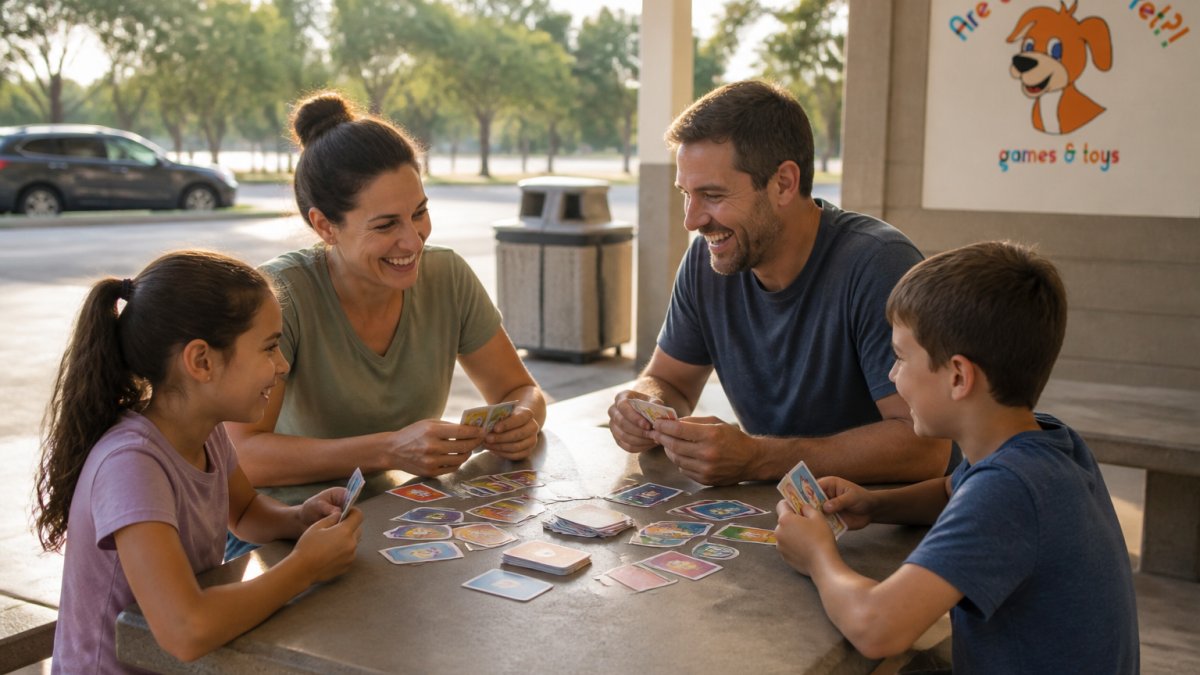
Card games beat screens on long journeys for one practical reason: a card game is self-contained. Nothing to charge, nothing to download, nothing that dies halfway through Nebraska.
But "good for travel" isn't automatic, some card games are brilliant on a plane and miserable in a car.
What Makes a Card Game Travel-Friendly
A travel-friendly card game fits in a small box, sets up in under a minute, and plays in a space no bigger than a folded tray table. Those three traits matter more than theme or artwork.
Packability: Small Box, Big Difference
Packability is measurable, not a feeling. A deck that fits in a jacket pocket or seat-back pouch is portable; a shoebox-sized box is not.
When you're judging a game for a trip, ask three questions:
- Does the box survive being squashed in a carry-on?
- Can a child hold and shuffle the deck without help?
- Will it still fit once you've added snacks, headphones, and a water bottle?
Setup Time and Space Needs
Setup time is where most "travel" games quietly fail. If a game needs a large play area, dozens of pieces, or a rulebook read-aloud, it won't survive a cramped middle seat.
The best options are card-only games with rules you can explain in a sentence or two. Turn-based play suits tight quarters because only one person needs space at a time; route building, drafting, and tile laying games need elbow room you don't have on a plane.
Best Card Games for Road Trips: What to Look For
The best card games for road trips are quick to learn, quick to play, and forgiving when the car hits a pothole. But "road trip" covers two very different situations, parked at a picnic table and strapped in at highway speed, and the right game changes depending on which one you're in.
Score a Game Before You Pack It
Here's how we'd score a game before packing it:
| What to Check | Why It Matters | Red Flag |
|---|---|---|
| Setup time | Kids lose interest fast while you read rules | More than 2 minutes |
| Play area | Tray tables and laps are tiny | Needs a full table |
| Playtime | Long journeys have short attention windows | Over 20 minutes per round |
| Player count | Two-player and group play both happen | Only plays with 4+ |
| Durability | Cards get bent, dropped, and chewed | Flimsy card stock |
| Replayability | One round is never enough | Same outcome every time |
| Card size and font | Reading in a moving car is hard | Tiny text, dense icons |
Games That Work While the Car Is Moving
Most card games assume a stable surface and a player who can look down without getting queasy. The formats that survive motion are:
- Call-and-response and guessing games where one person holds the cards and everyone else plays verbally
- Category and word games that need no table at all
- Pass-and-play matching games with large, high-contrast cards a child can hold in a lap
Classic decks like UNO, Spot It!, and Phase 10 are the ones most families already own, each with trade-offs. UNO is cheap and universally understood but its small numbers are hard to read in a jostling car. Spot It! is fast and needs almost no space, but demands steady eyes. Phase 10 plays well in a group but can outlast a child's patience.
Our own Go Poop! sits in the middle of that range: matching mechanics, chunky illustrations, and rounds short enough to stop when the food arrives.
Games for Rest Stops, Hotel Rooms, and Picnic Tables
Once you have a flat surface, the field opens up: drafting, set-collection, and light strategy games earn their place in the bag. The trade-off is setup, a game that takes five minutes to lay out is fine at a hotel table and miserable on a tray table.
A practical rule: pack one motion-friendly game for the drive and one table-friendly game for the destination. That covers both halves of the trip without doubling your luggage.
Measurable Portability
"Portable" is a feeling until you measure it. Compare four numbers: packed dimensions, packed weight, setup time, and minimum play surface.
When you're judging a game for a trip, ask three questions:
- Does the box survive being squashed in a carry-on?
- Can a child hold and shuffle the deck without help?
- Will it still fit once you've added snacks, headphones, and a water bottle?
Travel Card Games for Kids: Matching Ages and Abilities
Travel card games for kids work best when the rules match the child's actual patience and reading level, not their age on paper. Age ranges on a box are a starting point, not a guarantee, the real test is whether the child can hold the cards, follow turn order, and understand the win condition without an adult translating every move.
Games for Younger Kids (Ages 3-6)
For younger kids, look for matching and sorting mechanics: no reading, no counting beyond a few cards, no complex turns. Oversized cards are easier for small hands, and bold, high-contrast illustrations help kids who can't yet read.
Our Go Poop! game was built exactly for this age range: a silly matching game for 2-4 players ages 4 and up, where players collect sets of three cards, a magical creature, its favorite treat, and its colorful poop.
The Potty Cards add a light layer of strategy, so older siblings can experiment while the little ones enjoy the silly pictures.
Games for Older Kids (Ages 7-12)
Older kids want more bite: turn-based strategy, light bluffing, and games where the outcome isn't obvious in the first round.
Go Poop! Silly Card Game for Kids on the Go →
Look for games with:
- A clear win condition they can chase
- Enough variety that round three doesn't feel like round one
- Rules simple enough to teach a friend or a grandparent
This is the age where replayability matters most. A game your ten-year-old can teach to a cousin gets played for years, not one trip.
Accessibility and Inclusive Play
A game that only works for one kind of player isn't a travel game. Before you pack, run through a short accessibility checklist:
- Print size. Can a grandparent read the cards without holding them at arm's length? Large-print decks exist for exactly this reason.
- Color reliance. Many matching games use color as the only cue. Color-blind-friendly designs add shapes, patterns, or symbols alongside color so the game still works.
- Language dependence. Word games are wonderful until you're playing with someone still learning English or a child who reads slowly. Matching and symbol games cross that barrier.
- Dexterity demands. Shuffling, dealing, and flicking cards are hard for small hands and for anyone with limited fine motor control. Games that let one person hold the deck solve this.
- Age mixing. The best family travel games let a younger player compete without being carried and an older player compete without being bored.
When No Cards Are Possible
Sometimes the cards can't come out at all, a child is motion sick, the seat is too tight, or tray tables are up. That's when verbal games earn their place: Twenty Questions, I Spy, category naming, and story-building need nothing but voices. Keep one or two in your back pocket as a bridge until you reach a surface you can play on.
Screen-Free Travel Games: Why Card Games Beat Devices on the Road
Screen-free travel games win on long journeys because they don't run out of battery, don't need a signal, and don't turn a car full of people into a car full of separate screens.
A card game forces eye contact, making siblings negotiate, tease, and laugh at the same joke at the same time. Devices are excellent at occupying one child and terrible at connecting a family.
There's also the practical angle: tablets need charging, and charging needs an outlet you may not have.
The trade-off is honest: a screen holds a child's attention longer than almost any game.
Easy Card Games for Kids: Quick to Learn, Quick to Play
Easy card games for kids share one quality: you can explain the rules in under a minute. If it takes longer, you've lost the room before the first hand.
The simplest formats to look for are:
- Matching games where players collect sets
- Guessing games where players ask yes-or-no questions
- Word games built on categories or quick-thinking
- Party games that work with a group and don't need a table
Quick-to-play rounds matter as much as quick-to-learn rules. A five-minute round lets a child who loses try again immediately, and lets you stop the moment the food arrives or the plane boards.
Keeping Cards Usable and Together While Traveling
Cards get lost, bent, and sticky on trips, and a deck missing its seven of hearts stops working. A little planning keeps your games playable for years.
A few habits that hold up in practice:
- Keep each deck in its own zip pouch or small tin
- Store cards in a card holder or band them so they don't fan out in a bag
- Wipe sticky fingers before play, especially around snacks
- Avoid leaving cards on a hot dashboard, where they can warp
- Count the deck before you pack it away at the end of a trip
Durability matters too: cards that survive a week of travel usually survive a year of it. If a game becomes a family favorite, a second copy for the car is a reasonable investment.
When Card Games Are Not the Right Fit
Card games aren't the answer for every trip, and there are real situations where they fall short.
Card games also struggle in genuinely tight spaces, a packed economy seat with no tray table is not a play area.
Every trip has that moment: the snacks are gone, the scenery has gone boring, and someone in the back seat is about to ask the question you dread.
Frequently Asked Questions
Are card games good for travel?
Yes, for most trips. Card games travel well because they are compact, lightweight, and need no batteries or Wi-Fi. They work on planes, trains, in cars, and in hotel rooms. The main limits are small tray tables and windy outdoor settings. A standard deck or a compact card game takes up less space than a paperback book and gives you hours of entertainment for the whole family.
What makes a card game easy to pack for a trip?
Look for a small box that fits in a carry-on pocket, a deck that stays together without rubber bands, and rules that fit on one card. Games with oversized boards or many loose pieces are harder to pack. A game like Go Poop! Silly Card Game for Kids on the Go comes in a compact box designed for travel, with simple rules and cards that store easily in a backpack or glove compartment.
How do you keep cards from getting lost while traveling?
Use a small card holder, a resealable bag, or the original box with a rubber band around it. Count the cards before and after each play session, especially in the car where cards can slip between seats. For younger kids, a shallow tray or a piece of felt on the lap helps keep cards in one place. A dedicated travel bag for games also prevents cards from scattering in a suitcase.
What are some good card games for kids to play by themselves while traveling?
Solitaire games like Klondike or Accordion work with a standard deck. Matching and sorting games also work solo. Go Poop! can be played as a memory matching game or sorting game for younger kids who are not ready for full gameplay. These options keep kids engaged without needing a second player, which is helpful on long flights or when a sibling is asleep.


