

Asmodee Games Alternatives for Kids: Screen-Free Options
Table of Contents
- Why Parents Choose Asmodee Games Alternatives for Kids
- Best Travel Games for Kids Beyond Major Brands
- Asmodee vs Gamewright for Families: Key Differences
- Screen-Free Activities for Road Trips That Actually Stick
- Age-Appropriate Game Mechanics: Finding the Right Fit
- How to Evaluate Quality and Durability in Travel Games
- Building a Rotation Strategy So Games Stay Fresh
- Frequently Asked Questions
Last Updated: September 23, 2026
Why Parents Choose Asmodee Games Alternatives for Kids
Parents seeking Asmodee games alternatives kids often discover that major brand names aren't always the best fit for their family's needs, budget, or travel style. The real decision comes down to what holds a child's attention during a six-hour flight versus what looks good on a shelf at home.
What families really need is portable entertainment that doesn't require screens, batteries, or durability concerns. The best alternatives range from indie designers to established brands focused on travel-friendly mechanics. What sets them apart is thoughtful design that understands how kids actually play on the road.
Parents are getting smarter about what works in real-world travel conditions. A game requiring a large board, dozens of pieces, or complex setup won't survive your carry-on. Tiny components disappear under airplane seats. The best alternatives prioritize portability, durability, and genuine engagement over licensed characters or premium packaging.
Best Travel Games for Kids Beyond Major Brands
The strongest alternatives are designed by people who actually travel with kids. Travel-specific designers understand that games must survive backpacks, tray tables, and accidental bumps while resetting quickly.
Card-based games dominate because they solve the portability problem. Games like Gamewright titles feature simple mechanics kids grasp in under two minutes with enough strategic depth for older children. The best work across multiple age ranges so a 5-year-old and 9-year-old can play together.
Cooperative games have become increasingly popular among travel-focused designers. Instead of competitive play breeding frustration, cooperative mechanics mean everyone works toward a shared goal, extending engagement significantly.
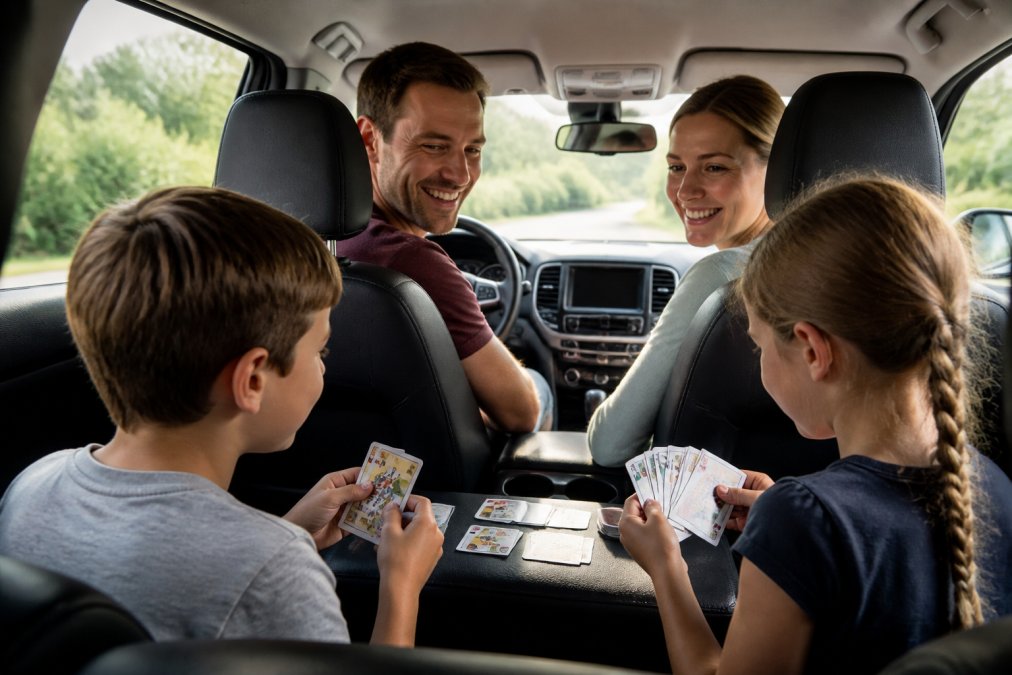
Travel games must handle interruptions without losing momentum. Setup time matters enormously, games taking 10 minutes are impractical, while those starting in 30 seconds are used repeatedly.
Component quality directly impacts longevity. Cheap cardstock wears out quickly; thin cards bend and crease; soft plastic dice chip and become unbalanced. Smaller designers often invest more in quality because their reputation depends on word-of-mouth.
What Makes a Travel Game Work for Long Journeys
Travel games must function in confined spaces with minimal setup, ideally smaller than a paperback book, starting in under one minute, and accommodating frequent pauses.
Travel games typically play in 30 to 45 minutes rather than 60 to 90 minutes. A 45-minute game can be reset and replayed; a 90-minute game consumes most of a flight, leaving nothing for round two.
Noise level is critical. Dice rolling and flicking pieces bother other travelers. Card games and turn-based mechanics are inherently quieter, which is why Asmodee games alternatives for kids often emphasize card-based play.
Asmodee vs Gamewright for Families: Key Differences
Asmodee, as a massive publisher, produces games across dozens of categories and complexity levels. Their strength is breadth; their weakness is that most games aren't specifically designed with travel in mind.
Gamewright built its reputation on portable, family-friendly card games. Nearly everything is travel-conscious with minimal setup and accessible rules. The tradeoff is less variety, they focus on what works rather than covering every category.
The question isn't which publisher is "better" overall, but which philosophy matches your family's needs. Asmodee offers breadth across categories; Gamewright offers games specifically engineered for travel.
Both publishers price competitively. The real difference is what you're paying for: Asmodee's licensing and scale versus Gamewright's specialized design focus.
Screen-Free Activities for Road Trips That Actually Stick
The best screen-free activities for road trips succeed because they solve a fundamental problem: boredom on long drives isn't about lacking options, it's about finding activities that maintain engagement across hours, not minutes. Games work because they have built-in replayability. You can play the same game multiple times and get different experiences.
Beyond games, the most effective screen-free strategies combine multiple activity types. A game session, a drawing activity, a travel journal, and a listening activity (audiobook or podcast) distributed across the journey prevents activity fatigue. Kids get bored with any single activity after 45 to 60 minutes, no matter how engaging.
Travel-specific games have an advantage over generic activities because they're interactive. A coloring book provides 30 to 45 minutes of engagement. A game provides 30 to 45 minutes of engagement plus the mental stimulation of strategy or problem-solving. The cognitive engagement means kids remember the activity positively and ask to play again, rather than viewing it as "something to do when bored."
Parents who build successful road trip entertainment strategies typically rotate between game-based activities and other screen-free options. The games serve as the anchor activities, the ones you know will work, while other activities provide variety.
Portable Card Games vs. Board Games for Travel
Card games and board games represent different tradeoffs for travel. Card games win on portability, setup speed, and space efficiency. Board games offer more complex strategic depth and longer engagement sessions.
For travel specifically, card games dominate because they solve the practical constraints of travel better. A card game fits in a pocket. A board game requires a flat surface and space for the board plus cards plus pieces. On an airplane with a tray table, card games work. Board games become frustrating.
However, some portable board games exist that bridge this gap. Games with folding boards or games played on a grid that the game itself provides can work in travel contexts. These are rarer than card games but worth seeking out if your family prefers board game mechanics.
The practical answer for most families: start with card games for travel. They're easier to manage, faster to set up, and less likely to have pieces go missing. If your family consistently wants more complex gameplay, add one portable board game to your collection.
| Game Type | Setup Time | Space Required | Best For | Durability |
|---|---|---|---|---|
| Card Games | Under 1 minute | Paperback-sized | Quick sessions, frequent replays | High if quality cardstock |
| Portable Board Games | 2-5 minutes | Laptop-sized | Longer engagement, complex strategy | Medium to high |
| Dice Games | 1-2 minutes | Small box | Simple mechanics, quick rounds | High |
| Tile-Based Games | 2-3 minutes | Medium box | Visual learners, pattern recognition | High |
Age-Appropriate Game Mechanics: Finding the Right Fit
Choosing age-appropriate game mechanics requires understanding what cognitive skills your child has developed and what challenges they can handle without frustration. A 4-year-old needs games with turn-based mechanics and obvious win conditions. A 7-year-old can handle simultaneous play and hidden information. A 10-year-old can manage complex rule sets and strategic planning across multiple turns.
The best Asmodee games alternatives kids often succeed because they match mechanics to age more precisely than mass-market publishers do.
How to Evaluate Quality and Durability in Travel Games
Quality assessment for travel games focuses on practical durability rather than aesthetic polish. A beautiful game that falls apart after five plays is worse than a plain game that survives 50 plays.
Building a Rotation Strategy So Games Stay Fresh
The biggest mistake parents make with travel games is treating them as permanent solutions rather than rotating activities. A game that's exciting on day one becomes routine by day five if it's the only game available.
Frequently Asked Questions
What are the best travel games for kids on long flights and road trips?
The best travel games for kids combine compact size, quick setup, and engaging gameplay that holds attention for 30 minutes or more. Look for games with minimal components, clear rules that don't require a rulebook mid-play, and mechanics that work for your child's age. Card games, dice games, and pattern-matching games tend to work well because they pack flat and don't require a large play surface. Screen-free activities for road trips should also offer enough variety that children don't exhaust the game in one sitting.
How do Asmodee vs Gamewright for families compare in terms of quality and value?
Asmodee games tend to focus on licensed properties and complex mechanics, often targeting older children and families with gaming experience. Gamewright specializes in original designs for younger players, with simpler rules and faster play times. Gamewright games typically cost less and travel better due to smaller boxes. For families new to board gaming or with younger children, Gamewright often provides better value and accessibility. Asmodee works better if your family enjoys deeper strategy or specific licensed themes.
What makes a game truly screen-free and engaging for kids ages 4 to 10?
Genuinely engaging screen-free activities for road trips require three elements: immediate understanding (rules kids grasp in under two minutes), interactive gameplay (taking turns or collaborative play that keeps everyone involved), and a natural stopping point (games that finish in 15-45 minutes). Games that rely on memory, pattern recognition, or simple strategy tend to hold attention better than purely luck-based games. Avoid games with too many small pieces, complex scoring, or downtime between turns.
How do I know if a game will actually hold my child's attention for a 6-hour flight?
Plan for a rotation rather than relying on a single game. Most children engage deeply with one game for 30-45 minutes before attention drops. Bring 3-4 different games so you can switch when interest wanes. Choose games with different mechanics (one card game, one dice game, one pattern game) so variety stays fresh. Games with replayability, where outcomes differ each time, work better than games with a fixed solution. Also consider your child's personality: easily frustrated children need games where luck plays a role, while competitive kids enjoy head-to-head matchups.


