

How to Stop Kids From Getting Bored: 7 Proven Strategies
Table of Contents
- Why Kids Get Bored and Why That's Actually Normal
- The Real Benefits of Boredom for Creativity and Problem-Solving
- What to Do When Kids Are Bored: A Parent Response Plan
- Screen-Free Activities for Kids That Actually Hold Their Attention
- How to Keep Kids Entertained on Planes and Long Flights
- How to Entertain Kids on a Road Trip: Practical Strategies
- Building Independent Play and Self-Direction
- When Boredom May Signal Something Deeper
- Frequently Asked Questions
Last Updated: October 11, 2026
Why Kids Get Bored and Why That's Actually Normal
Boredom is a normal, healthy signal that your child's brain is ready for something new, not a failure or emergency.
Kids get bored when they've mastered an activity, need mental stimulation, or are transitioning between tasks, and knowing how to stop kids from getting bored doesn't require immediate screen time or constant entertainment.
How you respond to boredom shapes your child's ability to self-entertain. When kids sit with boredom, they develop patience, creativity, and problem-solving skills.
The Real Benefits of Boredom for Creativity and Problem-Solving
Boredom is where creativity lives. When your child's mind isn't fed constant stimulation, it creates its own entertainment.
During unstructured play, children invent games, combine toys, and create stories, none of which happens passively on screens. Boredom forces the brain to work, building creative thinking.
Problem-solving skills develop when children decide what to do next: try something harder, switch activities, or combine toys. These decisions build self-direction and resilience.
Children who spend time in unstructured, screen-free play develop stronger attention spans and better emotional regulation. Boredom teaches patience and the reality that not every moment needs to be exciting.
What to Do When Kids Are Bored: A Parent Response Plan
When your child says "I'm bored," resist the urge to immediately fix it. Use this response plan:
Step 1: Acknowledge, "I hear you. Boredom happens." Step 2: Ask a guiding question, "What sounds fun to you right now?" Let them come up with ideas. Step 3: Offer 2-3 choices, "Would you like to play a card game, draw, or read?" Step 4: Step back, Let them choose and play. Be present but not engaged.
Screen-Free Activities for Kids That Actually Hold Their Attention
Screen-free activities require active participation, keeping brains engaged longer than videos. The key is matching activities to your child's developmental stage and attention span.
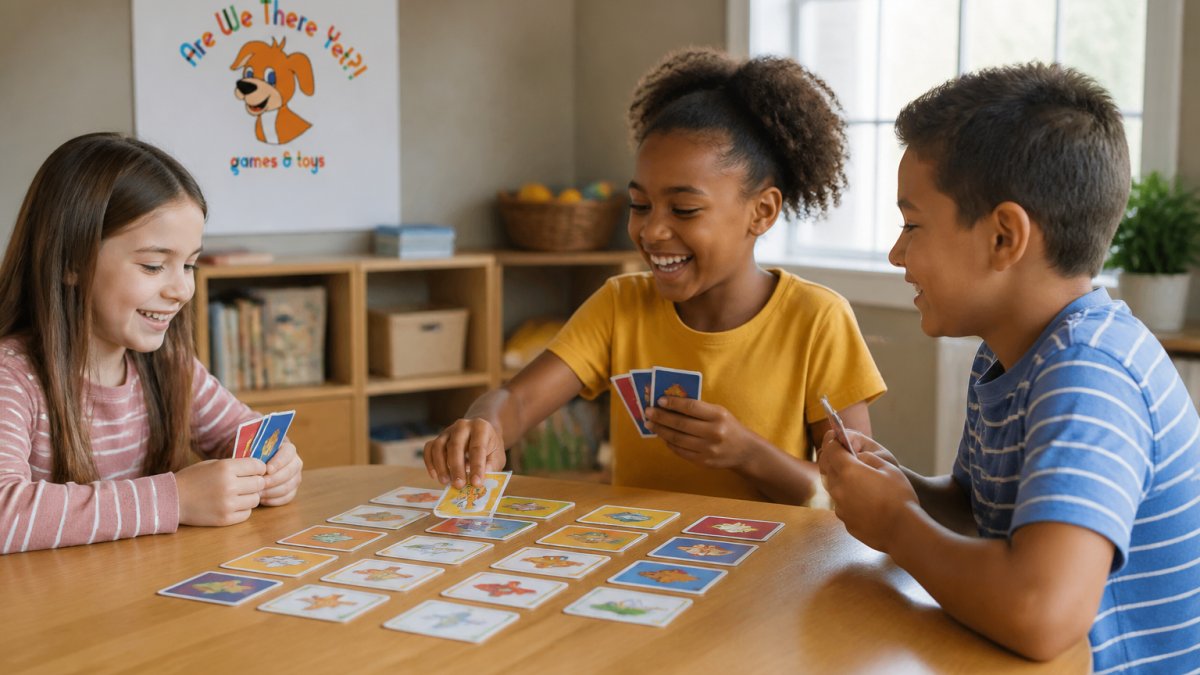
For Toddlers and Preschoolers (Ages 2-5)
Toddlers have short attention spans (5-10 minutes) and are driven by sensory exploration. They need engagement through touch, sound, and movement, not complexity.
Best activities:
- Sticker books and reusable sticker scenes combine fine motor practice with immediate feedback and repeatability.
- Coloring and scribbling with chunky crayons and large paper teaches cause and effect.
- Simple matching games with 6-8 pairs or Go Fish keep toddlers engaged through small wins.
- Sensory bins with pasta, sand, or water and small toys hold attention through tactile exploration.
- Picture books and read-alouds satisfy toddlers' love of repetition.
For School-Age Children (Ages 6-11)
School-age children can focus for 15-30 minutes and enjoy activities with clear rules, goals, and a sense of achievement.
Best activities:
- Card games with simple strategy like Go Fish, Crazy Eights, Uno, or Go Poop! work because they have rules, turns, and a winner.
- Puzzles (100-300 pieces) with clear images occupy children for 30-60 minutes and offer repeatability.
- Drawing and creative projects with prompts ("Draw your dream house," "Create a map") reduce blank-page paralysis and extend engagement.
- Building activities with LEGO, magnetic tiles, or wooden blocks combine creativity with structure and clear goals.
- Storytelling and writing with prompts spark 20-30 minutes of imaginative play.
- Board games designed for travel (magnetic chess, dice games, compact strategy games) have clear rules and defined endpoints (15-30 minutes).
For Tweens and Teens (Ages 12+)
Tweens and teens need age-appropriate activities offering autonomy, challenge, or social connection. Frame options as choices, not entertainment.

Best activities:
- Strategy games and card games with depth requiring planning, risk assessment, or negotiation hold attention longer.
- Creative projects with real outcomes like journaling, graphic novels, or comic creation feel more mature and engaging.
- Puzzles and brain teasers (500+ pieces or logic puzzles) appeal to problem-solving drives.
- Skill-building activities like drawing, origami, or magic tricks give tweens and teens a sense of mastery.
- Social games (card games, board games, word games) appeal more than solo activities and become social events.
Universal Principles Across All Ages
The best screen-free activities share these traits: clear structure (puzzle solutions, game rules, end results), immediate feedback (stickers placed, cards matched), low setup burden (accessible supplies), and repeatability (reusable stickers, card games, puzzles).
How to Keep Kids Entertained on Planes and Long Flights
Planes present a unique challenge: kids are confined, movement is limited, and duration is fixed. Sequence activities to match your child's energy at each flight stage.
Understanding the Flight Timeline
Most flights follow a predictable pattern: takeoff (high energy), cruise (restlessness peaks), and descent (fatigue). Align your activity strategy with these phases.
Takeoff and early flight (first 30 minutes): Let kids enjoy the plane's novelty, watching boarding, looking out the window, or settling in. Save best activities for later.
Mid-flight (30 minutes to 2 hours before landing): Deploy your most engaging activities, card games, puzzles, or interactive games, when restlessness peaks.
Final descent (last 30 minutes): Use screen time or quiet activities (reading, coloring) to keep kids calm.
Packing Strategy: Rotation Over Quantity
Pack variety over quantity: one coloring book, one card game, one puzzle, one activity book, one craft project. Switching between different activities feels fresh.
Under 3 hours: 1 card game, 1 small puzzle, 1 coloring book, 1 activity book, snacks. 3-6 hours: 2 card games, 2 puzzles, 1 coloring book, 1 activity book, 1 craft project, snacks, 1 surprise activity mid-flight. Over 6 hours: 3-4 rotating games, mix of solo and interactive activities, mid-flight surprise, screen time for final 1-2 hours, comfort items.
Activity Sequencing During the Flight
Timing is as important as what you pack. Well-timed transitions prevent meltdowns and manage energy.
Example 4-hour flight sequence: Takeoff (window time, snack, coloring) → Early cruise (card game) → Mid-cruise (puzzle) → Late cruise (new activity reveal) → Final descent (quiet activity or screen).
Introduce a new activity every 30-45 minutes by rotating the same activities in a fresh sequence.
Practical Logistics for Plane Travel
Pack activities in a separate bag and pull them out strategically. Don't let kids see everything at once.
Bring a lap desk or clipboard to provide a stable surface for coloring, puzzles, or card games.
Use snacks strategically every 60-90 minutes. Avoid sugary snacks; opt for nuts, cheese, crackers, or fruit.
Go Poop! Silly Card Game for Kids on the Go →
Bring headphones and an audiobook or music playlist to occupy children for 30-60 minutes without screens.
Pack a surprise activity to reveal mid-flight when restlessness peaks. Novelty resets engagement for another 45 minutes.
Games That Work Well on Planes
Look for games that don't require large flat surfaces, have pieces that won't scatter, can be played in 15-30 minutes, and work for 2+ players.
Card games are ideal for planes, minimal space, held in hand, compact, and replayable. Go Poop! fits in a carry-on pocket and works for 2-4 players.
Magnetic games (chess, checkers, tic-tac-toe) work because the pieces stay in place during turbulence. Dice games require minimal setup and can be played quickly.
How to Entertain Kids on a Road Trip: Practical Strategies
Road trips are different from flights. Kids can move around. Stops happen. Energy builds and releases. Use this to your advantage.
Break the trip into segments. Stop every 1.5 to 2 hours. Let kids run around. This resets their energy and makes the next segment feel manageable.
During driving segments, rotate activities. Start with a car-friendly game. Move to quiet activities like coloring or reading. End with a snack break or a story.
Car games work well because they don't require a flat surface. License plate games. Alphabet games. Storytelling games. These keep kids engaged without needing a table.
Pack a road trip bag with items kids can access from their seats. Keep it simple: a few activities, some snacks, a blanket.
Screen time on a road trip is fine if needed, but it works best as a last resort. Use it on the final stretch when everyone is tired.
Building Independent Play and Self-Direction
The goal of all this isn't to keep your child entertained. It's to teach them how to entertain themselves. This is a skill, and it builds over time.
Start with short stretches. Ask your child to play independently for 10 minutes while you're nearby but not engaged. Gradually increase the time. After a few weeks, 20-30 minutes becomes normal.
During independent play, observe without intervening. If your child gets stuck, ask guiding questions instead of solving the problem. "What could you try next?" instead of "Here's what you should do."
Praise independence. When your child plays alone for 15 minutes without asking for help, notice it. "I saw you playing by yourself the whole time. That's awesome." This reinforces the behavior.
Create a play environment that supports independence. Stock accessible toys. Organize activities so kids can grab what they want. Remove barriers to play so your child doesn't need you to set everything up.
When Boredom May Signal Something Deeper
Most boredom is normal. But sometimes, persistent boredom or the inability to engage with activities signals something worth paying attention to.
Watch for patterns. Does your child get bored with everything after 5 minutes? Do they seem restless and unable to focus?
Anxiety can look like boredom. A child who is anxious might seem disengaged or unable to settle into play. They might jump between activities constantly.
ADHD can show up as difficulty focusing on activities that don't provide immediate stimulation.
Sometimes boredom is about overstimulation. Kids who've had too much screen time or too much structured activity sometimes struggle to engage with quiet play.
If you notice patterns that concern you, talk to your child's doctor or a child psychologist. Most boredom is normal and healthy.
Boredom isn't something to fear. It's an opportunity for your child to develop creativity, independence, and patience.
At Are We There Yet, we've built our entire product line around this idea. Our screen-free card games give kids something to do when boredom strikes, but they also teach kids how to entertain themselves without screens.
Start with one simple activity. A card game. A coloring book. A puzzle.
Frequently Asked Questions
Is it actually good for kids to be bored sometimes?
Yes. Boredom pushes children to use their imagination and creativity. When kids aren't constantly entertained, they develop problem-solving skills, learn to self-soothe, and discover their own interests. Research shows that unstructured time helps build resilience and independent thinking. The key is balancing natural boredom with supportive guidance and access to materials they can explore.
What are the best screen-free activities for kids on a long road trip?
Portable card games, travel-sized puzzles, coloring books, audiobooks, and conversation games work well. Pack a variety so kids can switch activities when interest wanes. Compact games like Go Poop! are designed specifically for travel and fit easily in a backpack. Rotate activities every 30-45 minutes, and include breaks for stretching. Mix structured games with open-ended play like storytelling or observation games.
How do I respond when my child says they're bored?
Avoid rushing to fix it. Instead, ask open-ended questions: 'What would you like to do?' or 'What sounds fun to you right now?' This builds problem-solving skills. Offer a few specific choices rather than unlimited options. Sometimes the best response is to acknowledge their feeling and then step back, let them sit with boredom for a bit before suggesting something. This teaches patience and self-direction.
How can I tell if boredom is a sign of something else, like ADHD or anxiety?
Occasional boredom is normal. However, if your child frequently seems unable to engage in any activity, shows extreme restlessness, has difficulty focusing even on things they usually enjoy, or displays emotional distress around downtime, talk to your pediatrician. These patterns might indicate attention challenges, anxiety, or other developmental concerns that benefit from professional evaluation.


